

A job requisition is a formal internal request submitted by a hiring manager to get approval to fill a position before any recruitment activity begins. The term is the recognized industry standard in human resources, and understanding the HR requisition process is the first step toward building a hiring workflow that stays on budget and on strategy. For HR professionals and small business owners in fields like HVAC, plumbing, retail, and janitorial services, a solid requisition process prevents the reactive, unbudgeted hires that quietly drain cash flow and create compliance headaches.
What does requisition mean in HR, and why does it matter?
A job requisition is the official "starting gun" of the hiring cycle. It aligns a new hire with the company's budget and workforce plan before a single candidate is contacted. Without it, hiring managers can create positions that finance never approved and HR never vetted.
The requisition meaning in human resources goes beyond paperwork. It is the document that forces a business to answer three questions before spending money: Is this role necessary? Is it budgeted? Who has to sign off? Those three questions, answered in writing, protect small businesses from the most common hiring mistakes.
Key stakeholders in the process include the hiring manager, HR, and finance. In companies using an HRIS platform like Workday or BambooHR, the requisition lives inside the system and routes automatically for approval. In smaller businesses, it may be a shared Google Form or a simple PDF, but the function is identical.

What information does a job requisition include?
A comprehensive job requisition includes at least 10 standard components. Standardized templates promote consistency and support informed headcount decisions across the organization.
The core fields every requisition should contain:
- Hiring manager name and department. Establishes ownership and routes the request correctly.
- Job title and employment classification. Specifies whether the role is full-time, part-time, contract, or seasonal, and whether it is exempt or non-exempt under the Fair Labor Standards Act.
- Detailed role description. Summarizes duties, required skills, and reporting structure.
- Business justification. Explains why the role is needed now, ideally with workload data or revenue impact figures.
- Compensation range and budget code. Ties the hire to an approved budget line so finance can validate it immediately.
- Proposed start date and recruitment timeline. Sets expectations for HR and prevents the request from sitting idle.
- Required approvals and stakeholders. Lists everyone who must sign off before recruitment begins.
Pro Tip: Write the business justification with numbers, not feelings. "Our service calls increased 40% this quarter and one technician is handling work that requires two" is far stronger than "we are overwhelmed." Data-driven justifications reduce rejection rates and speed approvals.
How does a requisition differ from a job description and a job posting?
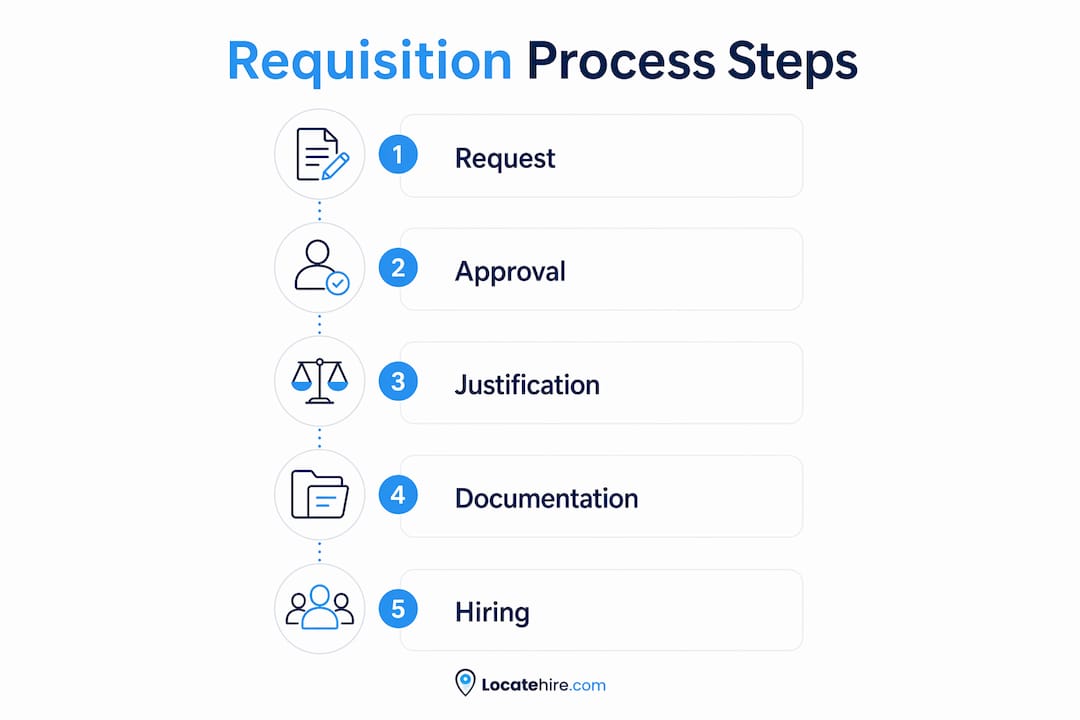
The sequence is clear: requisition first, then description, then posting. Confusing these three documents is one of the most common mistakes HR teams and small business owners make, and it costs time.
| Document | Purpose | Audience | Timing |
|---|---|---|---|
| Job requisition | Internal approval to hire | HR, finance, leadership | Before recruitment starts |
| Job description | Documents role duties and requirements | HR, hiring manager, legal | After requisition is approved |
| Job posting | Advertises the open role | External candidates | After description is finalized |
The job requisition is entirely internal. No candidate ever sees it. The job description is a working document that HR and the hiring manager use to align on expectations. The job posting is the public-facing advertisement, often shorter and more persuasive than the description.
A common mistake is skipping the requisition and writing a job posting first. This creates a situation where a role is advertised publicly before finance or leadership has approved the headcount. The result is either an embarrassing retraction or an unauthorized hire. Learning to avoid posting mistakes starts with respecting the sequence.
Pro Tip: Keep all three documents linked in your ATS or a shared folder. When an auditor or employment attorney asks for documentation on a hire, having the requisition, description, and posting together proves the process was followed correctly.
What is the typical job requisition approval process?
The approval process moves through a defined chain, and skipping any step creates risk. Here is the standard workflow most organizations follow:
- Hiring manager submits the requisition. The manager completes the form with all required fields, including business justification and budget code, and submits it through the HRIS or manually to HR.
- HR reviews for compliance and compensation alignment. HR acts as a gatekeeper, validating that the proposed salary is competitive, that the classification (exempt vs. non-exempt) is correct, and that the role does not duplicate an existing position.
- Finance confirms budget availability. Finance checks that the salary and any associated costs fit within the approved headcount budget for the period.
- Leadership or department head gives final approval. In smaller businesses, this may be the owner. In larger organizations, it may be a VP or COO.
- HR receives the approved requisition and begins recruitment. Only at this point does HR write the job description, post the role, or engage a recruiter.
Digital workflows integrated into ATS or HRIS platforms increase transparency and approval speed. Automation routes the form to the right approver, sends reminders, and creates a time-stamped audit trail.
The most common bottleneck is a weak business justification. Vague justifications are the primary cause of hiring approval delays. A hiring manager who writes "we need more help" will wait far longer than one who writes "ticket volume is up 35% and average response time has exceeded our SLA for six consecutive weeks."
Pro Tip: If your approval process regularly takes more than five business days, map the bottleneck. Usually it is one approver who lacks context. Attach a one-paragraph executive summary to every requisition so each approver can say yes without a meeting.
Understanding how to build a hiring process that connects requisition approval to recruitment timing is what separates businesses that hire well from those that scramble.
Why is the job requisition important for small businesses?
Small businesses feel the cost of a bad hire more acutely than large corporations. A plumbing company with eight technicians cannot absorb a misaligned hire the way a Fortune 500 company can. The requisition process is the first line of defense.
The practical benefits of a formal HR requisition process include:
- Budget control. Requisitions prevent unauthorized hires, unbudgeted expenditures, and duplicated roles. Every hire is tied to an approved budget line before recruitment begins.
- Audit trails for compliance. Documentation of who approved what and when protects businesses during labor audits, unemployment claims, and discrimination investigations.
- Workforce planning. The requisition process supports long-term workforce planning and prevents reactive hiring that can undermine organizational health. Reviewing open requisitions quarterly shows where the business is growing and where it is stretched.
- Payroll accuracy. HR must validate position classification (exempt vs. non-exempt) and market competitiveness of salary to avoid payroll and compliance risks. Getting this wrong at the requisition stage is far cheaper to fix than correcting it after someone is on payroll.
- Reduced time to hire. When the requisition is complete and approved before HR starts recruiting, there are no mid-process surprises. The role is defined, the budget is confirmed, and the recruiter can move fast.
Businesses that treat requisitions as a strategic tool rather than bureaucracy enjoy smoother hiring and better budget control. That shift in mindset is the difference between a business that grows its team deliberately and one that always feels like it is catching up. Pairing a solid requisition habit with the right recruitment software for small businesses creates a repeatable system that scales without chaos.
Key Takeaways
A job requisition is the formal internal approval document that initiates hiring, and skipping it leads to unauthorized hires, compliance gaps, and wasted recruitment spend.
| Point | Details |
|---|---|
| Requisition definition | A formal internal request for approval to hire, submitted before any recruitment activity begins. |
| Core components | Every requisition needs a business justification, compensation range, employment classification, and named approvers. |
| Sequence matters | The order is requisition, then job description, then job posting. Reversing this creates unauthorized hires. |
| Approval bottleneck | Vague business justifications cause most delays. Use workload data and metrics to speed approvals. |
| Small business value | Requisitions prevent unbudgeted hires, support compliance, and give small businesses a documented audit trail. |
The part most HR guides skip
Most articles on job requisitions treat the form as the point. The form is not the point. The conversation the form forces is the point.
When a hiring manager at a pool service company has to write down why they need a third route technician, they have to think. They have to quantify the workload, check the budget, and commit to a start date. That discipline catches a surprising number of hires that should never happen. I have seen small businesses avoid two or three unnecessary hires per year simply by requiring a written justification before HR does anything.
The other thing most guides miss is the HR gatekeeper role. HR is not just a rubber stamp in the approval chain. HR is the function that catches the manager who wants to classify a full-time worker as a contractor to avoid benefits, or the one who wants to pay below market and then wonders why nobody applies. Catching those problems at the requisition stage costs nothing. Catching them after a hire costs real money and sometimes legal fees.
My advice to small business owners is to start simple. A one-page requisition form with seven fields beats a 20-field enterprise template that nobody fills out correctly. Get the habit established first. Add complexity only when the business grows into it. And if your approval process takes more than a week, the problem is almost never the form. It is the absence of a clear owner at each approval step.
— Jeff
How Locatehire makes the requisition process work for small businesses
Running a pool service, HVAC, or retail operation means hiring is never a one-time event. You need a system that keeps up with ongoing demand without burying you in paperwork.
Locatehire is an applicant tracking system built specifically for small businesses with continuous hiring needs. It gives you a central place to submit and track requisitions, manage approvals, and move directly into recruiting once a position is green-lit. No more chasing down signatures or losing track of where a request is sitting. With Locatehire's AI-powered recruitment tools, you get the structure of an enterprise hiring process without the enterprise overhead. Start your free trial and see how fast a clean requisition workflow changes your hiring results.
FAQ
What does requisition mean in HR?
A job requisition is a formal internal document submitted by a hiring manager to request approval to fill a position. It initiates the hiring process and must be approved before recruitment begins.
What is the difference between a job requisition and a job description?
A job requisition is an internal approval request; a job description documents the duties and requirements of the role. The requisition comes first, and the description is written after approval is granted.
Who approves a job requisition?
Approval typically involves HR, finance, and a department head or business owner. HR validates compensation and compliance, finance confirms budget availability, and leadership gives final sign-off.
Why do small businesses need a formal requisition process?
A formal HR requisition process prevents unauthorized hires, creates an audit trail for compliance, and ties every new hire to an approved budget. It also reduces reactive hiring that strains cash flow.
Can a job requisition be rejected?
Yes. Requisitions are most often rejected due to vague business justifications, budget constraints, or duplicate roles. Submitting data-driven justifications with workload metrics significantly reduces rejection rates.