

The IBEW union's role in electrical hiring is to centrally manage skilled labor deployment through a dispatch system governed by collective bargaining agreements (CBAs), replacing direct contractor hiring with a coordinated allocation model. Contractors who sign with the IBEW do not recruit or interview individual journeymen. Instead, they place job calls with their local union hall, and the hall dispatches qualified members based on standardized eligibility lists. This system also feeds a structured apprenticeship pipeline requiring 8,000 hours of on-the-job training plus hundreds of classroom hours before a worker earns journeyman status. Understanding how this process works is the foundation of effective workforce planning for any signatory contractor.
How does the IBEW union dispatch system work for contractor hiring?
The IBEW dispatch system is the operational core of union electrical hiring. The local union hall acts as the labor exchange between contractors and members. When a contractor needs workers, they submit a job call to the hall, specifying the number of journeymen, the type of work, and the start date. The hall then assigns workers from its dispatch lists. Contractors do not interview or select individual journeymen. They receive whoever is next on the list.

The dispatch lists follow a priority structure built around two categories. Book 1 covers local members who live and work in the jurisdiction. Book 2 covers traveling members from other locals who are available for work. Dispatchers work through Book 1 first, then pull from Book 2 when local supply runs short. This structure gives contractors a reliable labor source but removes individual selection from the equation.
Key facts about how the dispatch process operates:
- Job calls are placed in advance. Contractors who wait until the week a project starts often face delays. Dispatchers need lead time to match available members to the call.
- Qualifications filter the list. Contractors can specify certifications or skills, such as high-voltage experience or instrumentation work, and dispatchers match accordingly.
- Labor market signals come from the hall. When Book 1 runs thin and dispatchers start pulling from Book 2, that signals a tight local market. Contractors who track this can plan ahead.
- Dispatcher relationships matter. Halls have discretion within the rules. Contractors who communicate clearly and consistently get better service.
Pro Tip: Call your local dispatcher before finalizing project timelines. If Book 1 is nearly depleted, build an extra two to four weeks into your labor procurement schedule.
Contractors who treat the dispatch system as a black box will struggle. Those who treat the dispatcher as a workforce partner get predictable results. The mutual dependency between signatory contractors and the union means both sides benefit when job calls are filled quickly and cleanly.
What is the IBEW apprenticeship pipeline and how does it feed hiring?
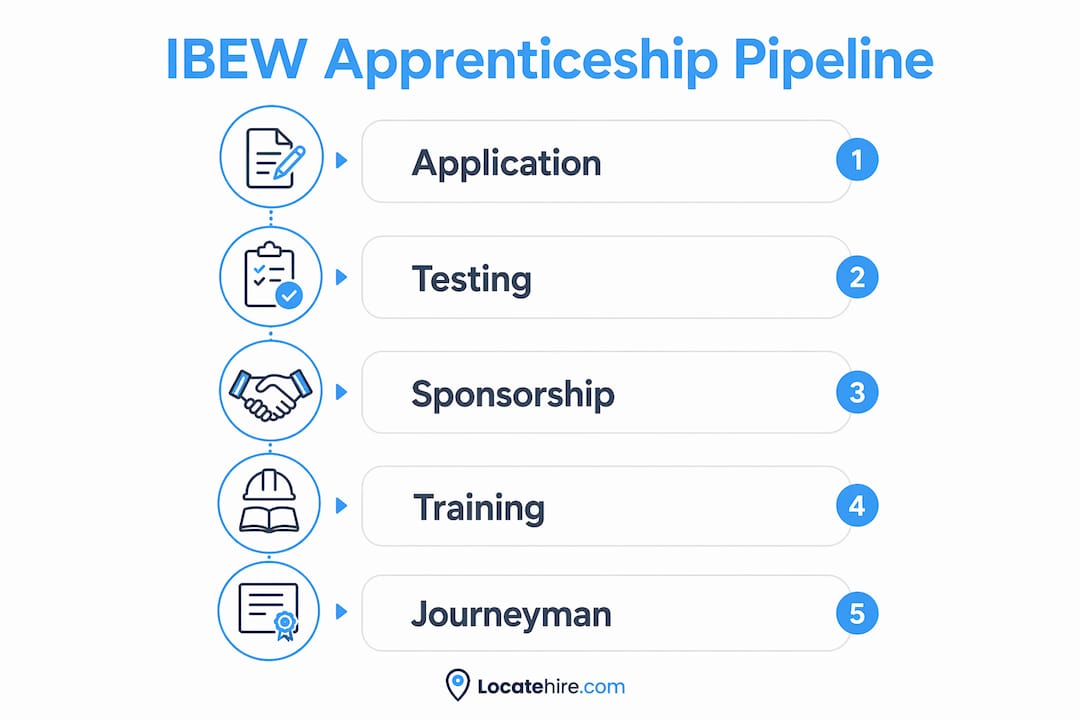
The IBEW apprenticeship program is the primary source of new journeymen entering the union hiring pool. It is one of the most structured skilled trades programs in the country. Completing it takes four to five years and requires both field hours and classroom time.
The program structure breaks down as follows:
- Application and testing. Candidates submit an application, pay a fee (commonly around $50), and take an aptitude test covering math and reading comprehension. Scores determine ranking on an eligibility list valid for up to two years.
- Interview and selection. Ranked candidates are called for interviews as openings become available. Documentation deadlines are strict, typically 30 days after notification.
- On-the-job training. Apprentices complete 8,000 hours of field work across the program's duration. This is not optional or compressible.
- Classroom instruction. Alongside field hours, apprentices complete 576–720 hours of classroom instruction covering electrical theory, the National Electrical Code, and safety standards.
- Journeyman licensing. After completing both components, apprentices qualify for journeyman status and enter the dispatch pool.
The Joint Apprenticeship and Training Committee (JATC) administers the program locally. Contractors sponsor apprentices through the JATC and absorb training costs during the program. That investment pays off when the apprentice completes the program as a fully credentialed journeyman.
| Stage | Duration | Key Requirement |
|---|---|---|
| Application and testing | One-time | Aptitude test, ranked eligibility list |
| Apprenticeship field hours | 4–5 years | 8,000 OJT hours |
| Classroom instruction | 4–5 years | 576–720 hours |
| Journeyman licensing | Upon completion | Full CBA wage rate eligibility |
Non-union apprenticeships exist but lack the standardization of the JATC model. They vary widely in hours, curriculum, and licensing outcomes. The IBEW program produces a journeyman whose qualifications are recognized across every signatory contractor in the country.
Pro Tip: Sponsor apprentices before you need them. A contractor who enters the JATC pipeline today gets a journeyman in four to five years. Waiting until labor is short means you are always behind the curve.
The apprenticeship pipeline relies on contractor sponsorship and long-term retention to generate a return on that investment. Contractors who sponsor apprentices and then lose them to competitors after licensing are funding someone else's workforce.
What are the benefits and challenges of hiring through the IBEW system?
The IBEW hiring system delivers real advantages, but it also creates constraints that contractors must plan around. Understanding both sides clearly is what separates contractors who thrive in a union environment from those who fight it.
The core benefits:
- Cost predictability. CBAs fix wages and benefits for the contract period. There are no surprise compensation negotiations mid-project.
- Skill standardization. Every dispatched journeyman has completed the same training program. Contractors know what they are getting.
- Grievance structure. Disputes follow a defined process. There is no ambiguity about how workplace issues get resolved.
- Labor supply access. In tight markets, signatory contractors get first access to the union's dispatch pool. Non-union shops have to recruit from scratch.
The real challenges:
- Higher labor costs. Union journeymen earn an average of $10.62 per hour more than non-union workers. In metro markets, that gap reaches $15–$20 per hour. The fully loaded union journeyman rate runs $52–$58 per hour.
- No individual selection. Contractors cannot choose which journeyman they receive. If a dispatched worker is a poor fit for the jobsite culture, the options for resolution are limited.
- Labor shortages still happen. The union dispatch system does not guarantee unlimited labor. When Book 1 runs dry and Book 2 is thin, job calls go unfilled.
"The IBEW is aggressively organizing to meet record construction labor demand in 2026, particularly in data center and tech infrastructure construction. Signatory contractors who align with that growth are positioned to access labor that non-union shops simply cannot find."
The IBEW International President's 2026 priorities center on meeting unprecedented demand in data centers and tech infrastructure through organizing drives and apprenticeship growth. Contractors working in those sectors who are already signatory have a structural advantage. Those who are not face a tightening non-union labor pool competing for the same projects.
For contractors managing costs, the wage premium is real but not the whole picture. A journeyman who shows up credentialed, trained, and ready to work on day one reduces supervision costs, rework, and safety incidents. That offsets a portion of the rate differential.
How can hiring managers navigate the IBEW hiring process effectively?
Hiring managers who treat the IBEW system as a passive process will consistently underperform. The contractors who get the best results treat it as an active workforce planning function.
Practical steps that work:
- Plan job calls months in advance. Tracking Book 1 and Book 2 availability tells you whether the local market can fill your call quickly or whether you need to plan for delays.
- Build a real relationship with your dispatcher. Call regularly, not just when you need workers. Dispatchers remember contractors who communicate professionally and consistently.
- Sponsor apprentices through the JATC. This is the single most effective long-term labor strategy available to signatory contractors. It builds your pipeline and creates loyalty.
- Use referral and retention programs. Winning contractors run referral bonuses, sponsor SkillBridge candidates, and offer lifestyle benefits to retain journeymen. The best-performing shops combine multiple retention tools simultaneously.
- Monitor organizing activity. When the IBEW runs a job blitz or organizing drive in your area, it signals that labor demand is outpacing supply. That is your cue to accelerate your own job calls before the pool tightens further.
- Track your apprentice completion rates. If apprentices are leaving before journeyman licensing, your retention strategy has a gap. Fix it before you invest in the next cohort.
Pro Tip: Ask your local dispatcher directly: "How many members are currently on Book 1?" That single number tells you more about your near-term labor supply than any market report.
The union hiring process rewards contractors who engage proactively. Passive contractors get whatever is left after the active ones have placed their calls.
For contractors managing multiple trades or locations, tracking job calls, apprentice status, and dispatcher communications across several locals becomes a real administrative challenge. Tools built for ongoing hiring needs, like Locatehire, help hiring managers keep that coordination organized without losing track of where each call or candidate stands.
Key Takeaways
The IBEW dispatch system is the definitive mechanism for union electrical hiring, and contractors who engage it proactively through advance job calls, JATC sponsorship, and dispatcher relationships consistently outperform those who treat it as a passive labor source.
| Point | Details |
|---|---|
| Dispatch replaces direct hiring | Contractors place job calls; the local hall assigns journeymen from Book 1 and Book 2 lists. |
| Apprenticeship is a 4–5 year investment | JATC programs require 8,000 OJT hours and 576–720 classroom hours before journeyman licensing. |
| Wage premium is real but manageable | Union journeymen cost $10.62/hr more on average; the trade-off is standardized skill and reduced rework. |
| Labor shortages still affect union contractors | Book 1 depletion signals tight supply; advance planning and JATC sponsorship are the best buffers. |
| Proactive engagement drives results | Dispatcher relationships, referral programs, and apprentice retention separate high-performing shops. |
What I've learned about contractors who win in the IBEW system
After watching contractors navigate union hiring across multiple markets, the pattern is clear. The ones who struggle are the ones who approach the IBEW system with a direct-hire mindset. They want to pick their workers, set their own pay scales, and move fast. The dispatch model does not work that way, and fighting it wastes energy that should go into workforce planning.
The contractors who consistently fill their job calls and keep their crews stable do three things differently. They sponsor apprentices early and often, they call their dispatcher before they need workers, and they invest in retention so their journeymen do not walk to the next job the moment it pays a dollar more. That last point matters more than most hiring managers realize. Losing a journeyman after two years costs you the relationship, the institutional knowledge, and often a referral to the next candidate.
The 2026 labor market makes this more urgent, not less. The IBEW's push into data center and tech infrastructure construction is creating demand that the current journeyman pool cannot fully meet. Contractors who are already in the JATC pipeline and maintaining strong dispatcher relationships will access that labor. Those who are not will be competing for a shrinking non-union pool at rates that are closing the gap with union wages anyway. The math increasingly favors the union system for contractors who plan ahead. For hiring managers thinking about how HVAC companies compete for talent in similar skilled trades markets, the same workforce planning principles apply directly to electrical.
— Jeff
Locatehire for contractors managing IBEW hiring coordination
Signatory electrical contractors juggle job calls across multiple locals, track apprentice progress through JATC programs, and monitor dispatcher availability, all while running active projects. That coordination load adds up fast.
Locatehire is an applicant tracking system built for small businesses with ongoing hiring needs, including electrical contractors working within union dispatch frameworks. It helps hiring managers track job call status, manage apprentice applicant records, and keep retention efforts organized across crews. For contractors sponsoring JATC apprentices or managing seasonal workforce shifts, Locatehire keeps every open position and candidate status in one place. See how it fits your operation at Locatehire.
FAQ
What is the IBEW dispatch system?
The IBEW dispatch system is a labor allocation model where the local union hall assigns journeymen to signatory contractors based on Book 1 and Book 2 eligibility lists. Contractors place job calls specifying their needs, and the hall dispatches qualified members without contractor interviews.
How do you join the IBEW union as an electrician?
Applicants take an aptitude test, complete an interview, and are ranked on an eligibility list valid for up to two years. Those selected enter a JATC apprenticeship requiring 8,000 OJT hours and up to 720 classroom hours over four to five years.
How much do union electricians cost compared to non-union?
Union journeymen earn an average of $10.62 per hour more than non-union electricians, with the fully loaded rate running $52–$58 per hour. The gap reaches $15–$20 per hour in metro markets and narrows to $2–$5 per hour in rural areas.
Can a contractor choose which journeyman gets dispatched?
No. The IBEW dispatch model means contractors hire the union's capacity, not individual workers. The hall assigns members based on list priority and qualifications, not contractor preference.
What is the JATC and why does it matter for contractors?
The Joint Apprenticeship and Training Committee administers the IBEW apprenticeship program locally. Contractors who sponsor apprentices through the JATC invest in training costs but gain fully credentialed journeymen after program completion, building a long-term labor pipeline.