

The fastest path to profitable scale in pool service is tighter route economics first, then higher-margin services, then repeatable hiring. Get those three in the right order and growth compounds. Reverse them and you add accounts while your margins shrink.
Three levers drive every successful expansion:
- Route density: Compact, geographically clustered routes cut unbillable drive time and lower your true cost-per-stop.
- Higher-value services: Repairs, equipment installs, and chemical retail generate revenue per visit that weekly cleaning alone cannot match.
- Repeatable hiring and training: A documented onboarding process lets you add technicians without service quality dropping.
Start today with one calculation: divide your total weekly labor hours (including drive time) by the number of stops completed. That number is your baseline cost-per-stop. If you do not know it, you cannot price correctly, hire safely, or buy a route with confidence.
Table of Contents
- Are you actually ready to scale your pool service business?
- Grow organically or buy an existing route?
- Which operational systems actually move the needle at scale?
- How to price for margin and measure cost-to-serve as you grow
- How to hire, onboard, and keep route technicians
- Adding repairs and equipment installs: what changes and what to protect
- Which marketing channels scale your customer acquisition reliably?
- KPIs, realistic timelines, and what scaling one route actually costs
- Your 90-day and 12-month action plan to scale without breaking things
- Key Takeaways
- The mistake most owners make when they try to scale
- Locatehire helps you hire faster when you are ready to grow
- Useful sources for pool service owners scaling their operations
Are you actually ready to scale your pool service business?
Many owners who stall at roughly 60 accounts are not failing at sales. They are running a business that is not yet ready to grow. Only 9% of pool service businesses ever hire their first employee, which means the bottleneck is almost always operational, not market-driven. Before you add a truck or buy a route, run this seven-point audit.

1. Route density check. Map your current accounts. Are most stops within a 10–15 minute drive of each other? A 20-account route clustered in adjacent neighborhoods outperforms a 25-account route spread across long distances because drive-time losses eat directly into margin.

2. True cost-per-stop. Add labor, chemicals, fuel, vehicle depreciation, and your own time. Divide by weekly stops. Most owners underestimate this by 20–30% because they exclude their own labor and vehicle wear.
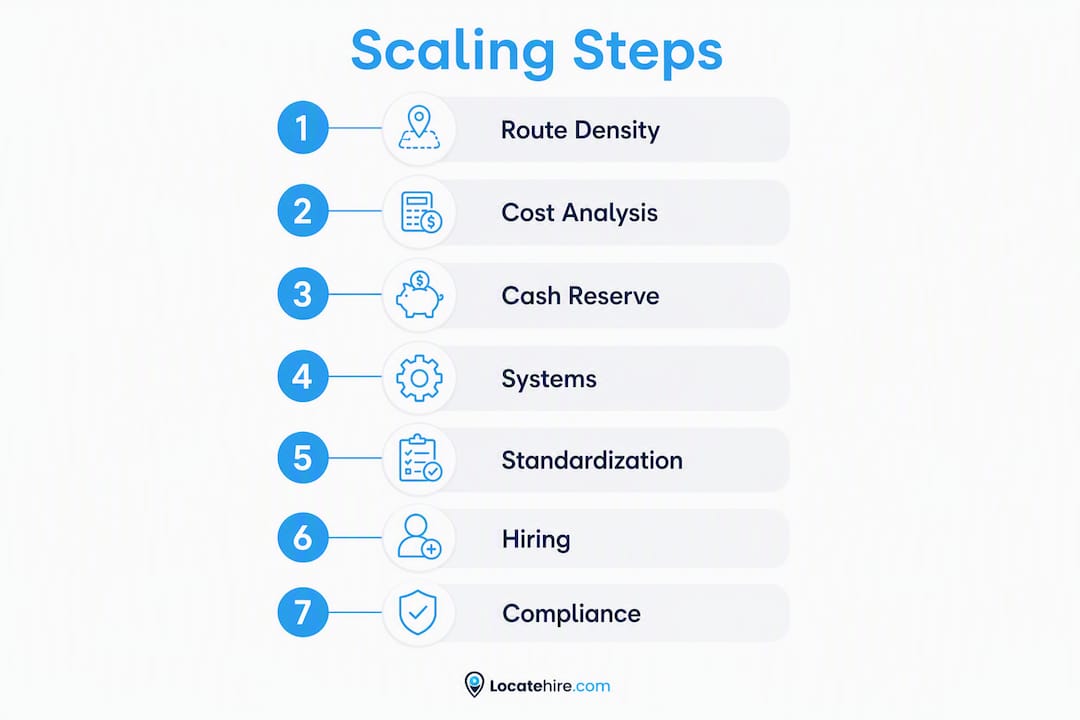
3. Cash runway. Do you have at least 60–90 days of operating expenses in reserve? Scaling requires upfront spend on labor, equipment, and marketing before new revenue arrives.
4. Software and systems. Are you scheduling, billing, and tracking service records in a single platform, or across texts, spreadsheets, and memory? Memory does not scale.
5. Documented SOPs. Can a new technician complete a service visit correctly without calling you? If the answer is no, you are the system, and that is the constraint.
6. Hiring bandwidth. Do you have time to recruit, interview, and onboard a technician in the next 30 days? Hiring while already at capacity produces bad hires.
7. Insurance and licensing alignment. Does your current coverage match the work you plan to add? Expanding into repairs or installs without updating your policy is a liability gap, not a cost savings.
Sample revenue-per-route benchmark: A healthy single route running 70 accounts at an average of $175/month generates roughly $12,250 in monthly recurring revenue. Labor should run at 30–35% of that figure. If your labor percentage is above 40%, fix route density before adding accounts.
Pro Tip: The most common readiness blind spot is underestimating cost-to-serve. Owners calculate chemical and labor costs but forget vehicle depreciation, callback time, and their own management hours. Build a simple spreadsheet that captures all six cost categories before you set a single price or make a hire.
Grow organically or buy an existing route?
The State of Pool Service 2026 confirms that software adoption, pricing discipline, and cost-to-serve analysis are central to confident growth, with six in ten businesses planning to add employees in 2026. That growth happens two ways: build it account by account, or buy an existing route. Each path suits a different stage and risk tolerance.
Organic growth works best when you have strong route density in a target area, a documented service process, and time to acquire customers through referrals, digital marketing, and property manager relationships. It is slower but preserves cash and avoids integration risk.
Route acquisition compresses the timeline. You pay a multiple of monthly recurring revenue (typically 8–12x monthly billings for a well-documented route) and inherit accounts, equipment, and sometimes staff. The speed is real. So is the risk if you skip due diligence.
Comparing the two paths
| Factor | Organic growth | Route acquisition |
|---|---|---|
| Speed to 50+ accounts | 12–24 months | 30–90 days |
| Upfront cash required | Low to moderate | High ($40K–$150K+ depending on route size) |
| Route density control | High | Depends on seller's geography |
| Customer retention risk | Low | Moderate to high (transition churn) |
| Integration complexity | Low | High (billing, SOPs, staff) |
| Best stage | Solo to first hire | First hire to multi-truck |
Route-buying due diligence checklist
Before signing a purchase agreement, verify each of the following:
- 12 months of service records showing account count, visit frequency, and chemical logs
- Customer contract terms (month-to-month vs. annual, cancellation clauses)
- Billing history with average invoice value and payment consistency
- Churn rate over the past 12 months (above 15% annually is a red flag)
- Pricing consistency (routes with widely varying prices per account signal undocumented deals)
- Equipment condition (truck, test kits, chemical inventory)
- Staff agreements if technicians are included in the sale
- Reason for sale (retirement is low risk; burnout or service complaints are not)
Red flags: Any seller who refuses to share service records, has more than 20% of accounts on verbal-only agreements, or cannot explain a spike in cancellations in the past six months deserves a hard pass or a significant price reduction.
Private equity roll-ups are more visible in 2026, which means clean books and documented unit economics matter whether you are buying or eventually selling.
Which operational systems actually move the needle at scale?
The operators who scale fastest are not running the most tools. They are running the fewest tools that cover the most ground. Survey data indicate that many scaling operators buy all-in-one solutions(https://21254957.fs1.hubspotusercontent-na1.net/hubfs/21254957/The%20State%20of%20Pool%20Service%20Report%202026.pdf), using software to automate routing, proof-of-service, billing, and reporting in a single stack.
Must-have features to prioritize:
- Route clustering and GPS routing: Automatically groups stops by geography to minimize drive time. This is the highest-ROI feature in any field ops platform.
- Recurring billing automation: Eliminates manual invoicing, reduces payment delays, and catches missed charges before they become revenue leakage.
- Proof-of-service documentation: Photo logs and digital checklists create accountability for technicians and reduce customer disputes.
- Inventory tracking: Monitors chemical usage per stop so you can catch overuse, theft, or billing gaps.
- Simple KPI dashboards: Revenue per route, cost-per-stop, and churn rate visible in one view. If you need a spreadsheet to find these numbers, you will not check them often enough.
- Integrated accounting sync: A direct connection to QuickBooks or Xero eliminates double-entry and keeps your P&L accurate in real time.
Implementation approach: Start with the field ops platform and accounting integration. Get those two talking to each other before adding anything else. Once billing accuracy and route data are clean, layer in inventory tracking and customer communication tools.
Pro Tip: Roll out new software in phases. Introduce routing and scheduling in week one, billing automation in week three, and reporting dashboards in week six. Trying to train a team on five new features simultaneously creates tool fatigue and data entry errors that take months to untangle.
Webinar panels with experienced operators consistently recommend bank-account-based cash splits, true cost-per-job baselines, and work orders with QA checks as the concrete practices that hold margins while growing. These are not glamorous features. They are the ones that prevent margin drift at 80 accounts from becoming a cash crisis at 120.
How to price for margin and measure cost-to-serve as you grow
Pricing discipline is where most pool service businesses lose the most money during expansion. The math is not complicated. The discipline to apply it consistently is.
Calculating your true cost-per-stop
Use this formula as your baseline:
(Weekly labor hours × hourly fully-loaded labor cost) + weekly chemical cost + weekly fuel/vehicle cost + weekly overhead allocation ÷ number of weekly stops = true cost-per-stop
Example: A technician earning $22/hour with benefits loaded to $28/hour, working 40 hours per week (including 8 hours of drive time), costs $1,120 in labor alone. Add $300 in chemicals, $120 in fuel, and $80 in overhead. Total weekly cost: $1,620. Divide by 32 billable stops: $50.63 true cost-per-stop. A route charging $130/month per account ($32.50/weekly visit) is losing money before the owner takes a draw.
Margin benchmarks to track
| Metric | Target range | Warning threshold |
|---|---|---|
| Labor as % of revenue | 30–35% | Above 40% |
| Chemical cost as % of revenue | 10–15% | — |
| Gross margin (cleaning only) | 50–60% | — |
| Gross margin (repairs/installs) | 40–55% | Below 35% |
| Net profit margin | 15–25% | Below 10% |
Wexford Insurance guidance notes a $250K–$400K revenue zone where cleaning-only businesses begin to feel capped. That ceiling is a pricing and margin problem as much as a volume problem. Businesses that break through it typically do so by adding repair and equipment revenue, not by adding more low-margin cleaning accounts.
Pricing tactics that protect retention
- Service tiers: A basic maintenance tier (chemicals + brush) and a premium tier (full equipment check, filter cleaning, priority scheduling) let you raise revenue per account without losing price-sensitive customers.
- Bundled maintenance plus add-ons: Offer a quarterly equipment inspection bundled into the monthly fee at a slight premium. Customers perceive value; you lock in higher average invoice value.
- Value-based pricing for installs: Equipment installations and major repairs should be priced on outcome value (a functioning heater, a safe electrical connection), not on hours. Flat-rate pricing for common repairs reduces customer friction and protects your margin when jobs run long.
Benchmark: Healthy pool service businesses running 70–100 accounts target $175–$225 per account per month for full-service maintenance. Anything below $150 in most U.S. markets signals underpricing relative to true cost-to-serve.
How to hire, onboard, and keep route technicians
Hiring is where pool service businesses stall most visibly. The jump from solo operator to first hire is the hardest transition in the business. Owners who stall at around 60 accounts typically need different skills at that stage: hiring, delegation, and systems, not better chemistry knowledge.
Recruiting playbook
Where to advertise:
- Indeed and ZipRecruiter for volume
- Facebook Jobs for local reach in your service area
- Nextdoor for community-based trust signals
- Trade school and community college job boards for entry-level candidates
Job ad essentials: State the pay range (not "competitive"), the truck situation (company vehicle vs. own vehicle), the start time, and the physical requirements. Vague ads attract unqualified applicants and waste your interview time.
Interview scorecard: Score candidates on reliability indicators (consistent employment history, references who answer the phone), mechanical aptitude, customer communication, and physical fitness. A structured scorecard reduces gut-feel hiring and makes it easier to compare candidates fairly.
Realistic hiring timeline: Post to hire in 2–3 weeks for entry-level technicians in most U.S. markets. Budget 3–4 weeks if you need certified applicants. Understanding common hiring challenges pool service companies face before you post saves time and reduces bad-fit hires.
30-60-90 day onboarding template
Days 1–30 (Technical foundation):
- Shadow the owner or lead tech on a full route for the first week
- Pass a written chemistry and equipment safety test by day 14
- Complete solo service visits on 10 assigned accounts with owner spot-checks
- Submit accurate service reports for every visit with no prompting
Days 31–60 (Process compliance):
- Manage a full assigned route independently with less than 5% callback rate
- Demonstrate correct chemical documentation on every visit
- Handle one customer complaint call without escalation
- Complete equipment troubleshooting checklist on three common issues
Days 61–90 (Customer communication and quality):
- Achieve 90%+ on-time completion rate for the assigned route
- Upsell or flag one repair opportunity per week (documented in the platform)
- Receive a positive customer feedback score on at least 80% of accounts
- Pass a 90-day performance review with documented scorecard
Staffing math
Use the formula (Total pools ÷ 70) × 1.15 to size your team. This buffer accounts for vacation, sick days, callbacks, and equipment issues that solo-operator math ignores. At 100 pools: (100 ÷ 70) × 1.15 = 1.64 FTE. That means two technicians, not one, to maintain service quality without burning anyone out.
Pro Tip: Post your next technician role 60 days before you need them, not the week you hit capacity. Reactive hiring produces bad fits. Proactive hiring lets you be selective. Knowing how pool industry hiring season works helps you time your posts before the spring rush drives up competition for qualified candidates.
Adding repairs and equipment installs: what changes and what to protect
Cleaning revenue has a natural ceiling. Expanding into repairs and installs changes your pricing logic, labor mix, insurance exposure, and scheduling complexity in ways that catch underprepared operators off guard.
The structural shift is real. Repair and install work is project-based, not recurring. It requires different scheduling (longer time blocks, parts procurement, permit coordination in some states), a different labor profile (certified or licensed technicians for electrical and gas work), and a different cash flow pattern (deposits, parts costs, and payment on completion rather than monthly autopay).
Insurance and compliance checklist
Before you take on repair or install work, verify each item:
| Item | What to check |
|---|---|
| General liability coverage | Confirm it covers repair and installation work, not just maintenance |
| Workers' compensation | Required in most U.S. states once you have employees; verify your state's threshold |
| Contractor's license | Required for electrical, gas, and structural work in most states; check your state licensing board |
| CPO certification | Certified Pool Operator credential adds credibility and is required for commercial accounts in many states |
| Bonding | Required for some commercial and HOA contracts |
| Equipment warranty compliance | Manufacturer warranties may require certified installers; verify before quoting |
Pricing guidelines for repair and install work:
- Diagnostic service calls: flat rate of $75–$125, credited toward repair if the customer proceeds
- Common repairs (pump replacement, filter cleaning, heater igniter): flat-rate pricing based on parts plus a fixed labor rate, typically $150–$400 depending on complexity
- Equipment installations (heater, automation system, variable-speed pump): project-based pricing with a 40–55% gross margin target
Subcontracting rule of thumb: If a job requires a license you do not hold (electrical, gas, structural), subcontract it rather than skip the license. Mark up the subcontractor's rate by 15–25% and manage the customer relationship. You keep the margin and the account; the sub carries the license risk.
Pro Tip: Start with repairs before installs. Repairs use your existing labor, require no new licensing in most cases, and generate immediate revenue. Installs require parts inventory, longer scheduling windows, and often a licensed sub. Sequence the expansion to match your operational readiness.
Which marketing channels scale your customer acquisition reliably?
Word-of-mouth fills a route at small scale. It does not grow one past 50 accounts with any predictability. Industry guidance recommends prioritizing Google Business Profile, targeted seasonal campaigns, and partnerships with property managers and builders for scaled acquisition.
Channel priority list:
- Google Business Profile (GBP): Free, high-intent, and the first thing a homeowner sees when searching "pool service near me." Optimize your profile with service categories, photos, and a consistent review request process. Aim for 20+ reviews before investing in paid ads.
- Local paid search (Google Ads): Target "pool cleaning [city]" and "pool service [zip code]" keywords. Customer acquisition cost (CAC) in most U.S. markets runs $80–$200 per new account. Set a monthly budget and track cost-per-lead, not just clicks.
- Property managers and HOAs: A single property manager relationship can deliver 5–20 accounts at once. Offer a dedicated account manager, monthly reporting, and priority scheduling. The sales cycle is longer (4–8 weeks), but the account lifetime value is significantly higher.
- Pool builders: New pool installations need a service provider from day one. A referral agreement with one or two local builders can generate 10–30 new accounts per year with near-zero CAC.
- Seasonal direct mail: Targeted postcards to homeowners in your service zip codes at the start of pool season (March–April in most U.S. markets) generate a predictable response rate and are easy to track with a unique phone number or landing page.
Google Business Profile setup checklist:
- Claim and verify your listing at business.google.com
- Add all service categories (pool cleaning, pool maintenance, pool repair)
- Upload 10+ photos of your team, trucks, and completed work
- Set up an automated review request text or email sent 24 hours after each service visit
- Respond to every review, positive or negative, within 48 hours
Tracking channel ROI: Assign a unique phone number or UTM-tagged landing page to each channel. Track cost-per-lead and cost-per-acquired-account monthly. After 90 days, cut the two lowest-performing channels and double the budget on the top performer. Digital marketing services built for small businesses can accelerate this process if you lack in-house capacity.
KPIs, realistic timelines, and what scaling one route actually costs
Growth without measurement is just spending. These are the numbers that tell you whether your expansion is working or eroding your margins.
Core KPIs with definitions:
- Revenue per route: Total monthly billing divided by number of active routes. Target: $10,000–$14,000/month per route at 70 accounts.
- Cost-per-stop: True weekly cost divided by billable stops (see the pricing section calculation). Target: below 40% of your average invoice value per visit.
- Monthly churn rate: Accounts lost ÷ total accounts at the start of the month. Target: below 2% monthly (under 20% annually).
- Average invoice value (AIV): Total monthly revenue ÷ total accounts. Rising AIV signals successful upselling; flat or falling AIV signals pricing pressure.
- Route density score: Average drive time between stops. Target: under 10 minutes average in your primary service area.
Sample 90-day and 12-month timeline
90-day sprint (0 to first hire):
- Week 1–2: Complete the readiness audit; calculate true cost-per-stop; map route density
- Week 3–4: Implement field ops software and billing automation
- Week 5–6: Post first technician role; begin interviewing
- Week 7–8: Hire and begin onboarding; owner shifts to route oversight
- Week 9–12: First tech runs solo route; owner focuses on sales and systems
12-month plan (first hire to second route):
- Months 1–3: Stabilize first hire; hit 90%+ service compliance; optimize route density
- Months 4–6: Add 15–20 accounts through GBP and one paid channel; evaluate route acquisition opportunities
- Months 7–9: Hire second technician using the staffing formula; begin repair service offering
- Months 10–12: Evaluate second route (organic or acquisition); review unit economics per route
Ballpark scaling costs
Your 90-day and 12-month action plan to scale without breaking things
Diagnosis without execution is just reading. Here is the prioritized sequence that moves a pool service business from stalled to scaling without premature hiring or a bad acquisition.
First 90 days: measure, fix, and hire once
- Calculate your true cost-per-stop using all six cost categories (labor, chemicals, fuel, vehicle depreciation, callbacks, overhead). This number drives every other decision.
- Map route density and identify the three to five accounts furthest from your cluster. Decide whether to reprice them, reassign them, or drop them.
- Implement one integrated software platform covering scheduling, billing, and service records. Do not add a second tool until the first is producing clean data.
- Document your top five SOPs (opening a pool, weekly maintenance checklist, chemical log, customer complaint process, billing dispute resolution). These are the foundation of your onboarding program.
- Post your first technician role using a structured job ad with pay range, schedule, and physical requirements. Use an applicant tracking system to score and compare candidates consistently.
- Onboard your first hire using the 30-60-90 template. Do not hand over a full route until day 30 milestones are met.
Months 4–12: build the second route
- Add 15–20 accounts through Google Business Profile and one paid channel. Track CAC per channel from day one.
- Introduce one repair service (pump replacement or filter cleaning) with flat-rate pricing and a documented process. Measure gross margin on repair work separately from cleaning.
- Apply the staffing formula before hiring a second technician: (Total pools ÷ 70) × 1.15. Hire when the formula says 1.8 or above, not when you feel overwhelmed.
- Review unit economics monthly: revenue per route, labor %, cost-per-stop, and churn rate. A single monthly review catches margin drift before it becomes a cash problem.
Buy vs. build decision rules
- Buy when you have 60+ days of cash runway after the purchase, the route has less than 15% annual churn, the geography overlaps your existing cluster, and the seller provides 12 months of clean service records.
- Build when cash is tight, your current route density is below target, or you have not yet documented your SOPs. Acquiring a route before your systems are solid doubles your problems.
Governance while delegating: Review each technician's route P&L weekly for the first 90 days. Set a callback rate threshold (above 8% triggers a review). Conduct one in-person spot-check per route per month. These three habits keep quality visible without requiring you to be on every job.
Key Takeaways
Scaling a pool service business profitably requires route density first, margin discipline second, and repeatable hiring third, in that order.
| Point | Details |
|---|---|
| Route density before volume | A compact 20-account route outperforms a spread 25-account route; fix geography before adding accounts. |
| Know your true cost-per-stop | Labor, chemicals, fuel, vehicle depreciation, and overhead must all be included before you set a price or hire. |
| Use the staffing formula | (Total pools ÷ 70) × 1.15 sizes your team accurately and prevents reactive, bad-fit hires. |
| Expand services before adding routes | Repairs and installs break the cleaning revenue ceiling; update insurance and licensing before taking on that work. |
| Locatehire removes the hiring bottleneck | An ATS with AI candidate matching and structured scorecards helps pool service owners hire faster and more consistently as they scale. |
The mistake most owners make when they try to scale
The conventional wisdom says pool service businesses stall because of market saturation or pricing pressure. That is rarely the real problem. The businesses that stall at 60 accounts almost always share one trait: the owner is still the best technician on the team, and the team knows it.
When the owner is the default answer to every service question, every callback, and every customer complaint, the business has a single point of failure. Adding accounts in that state does not scale the business. It scales the owner's stress.
The recovery pattern is consistent. The owner stops doing routine service work, documents the five to ten processes they have been carrying in their head, and hires one reliable technician with a structured onboarding plan. Not a great technician. A reliable one who follows a documented process. That distinction matters more than most owners expect.
The second mistake is treating software as a cost rather than a constraint-remover. Operators who resist field ops platforms because of the monthly fee are often spending three times that amount in unbilled callbacks, missed invoices, and scheduling errors they cannot see. The State of Pool Service 2026 data is clear: software adoption and pricing discipline are central to confident growth, not optional upgrades.
The third mistake is buying a route before the current operation is stable. A route acquisition accelerates whatever is already happening in your business. If your systems are solid, it accelerates growth. If your systems are fragile, it accelerates chaos.
Pro Tip: The mindset shift from technician to operator is not about working less. It is about working on different things. Schedule two hours every week for route P&L review, hiring, and process documentation. Protect those two hours the same way you protect a service appointment.
Locatehire helps you hire faster when you are ready to grow
The hiring bottleneck is real, and it shows up at the worst time: when you have the accounts to justify a new technician but not the bandwidth to recruit one properly. Locatehire is built for exactly this stage.
Pool service owners using Locatehire post open roles to major job boards and social media in minutes, then let AI candidate matching and smart scoring surface the strongest applicants automatically. No more sorting through unqualified resumes manually. Structured scorecards keep your interview process consistent so you compare candidates on the same criteria every time. New candidate alerts mean you respond fast, before the best applicants accept another offer.
When you are ready to hire your first technician or your fifth, start a pilot with one open role and measure time-to-hire against your current process. Most owners see a measurable reduction in time-to-hire within the first 30 days. That time goes back into running the business.
Useful sources for pool service owners scaling their operations
These sources informed this guide and are worth bookmarking for deeper data, templates, and industry benchmarks.
- The State of Pool Service 2026 — Annual industry report covering software adoption, pricing trends, staffing plans, and growth strategies across U.S. pool service businesses.
- Scaling Your Pool Service to 100 Pools: The Complete Operational Playbook — Practitioner-written guide from Pool Founder covering the solo-to-first-hire transition, route math, and operational systems.
- Pool Service Staffing Guide — Covers the staffing formula, hiring cadence, and buffer calculations for route-based businesses.
- How to Scale a Pool Service Business Beyond Weekly Pool Cleaning — Wexford Insurance guidance on the insurance, pricing, and operational changes required when expanding into repairs and installs.
- The 2026 Pool Service Growth Playbook — Stage-based growth framework covering the four phases from solo operator to regional business.
- Pool Service Marketing: 11 Effective Strategies — Tactical breakdown of digital and offline marketing channels for pool service businesses, including SEO, referrals, and retention pricing.
- United Pool Association — Industry association resource for licensing guidance, certification standards, and professional development for U.S. pool service operators.