

A one-page checklist plus a 30/60/90 review cadence is what turns a new hire into a safe, billable electrical field technician on a predictable timeline. The headline rule for readiness: paperwork and safety modules complete, mentor sign-off documented, and two supervised solo jobs finished with zero rework. Here's the snapshot version to copy today.
- Background check and offer paperwork signed before day one
- PPE sized and core tools issued
- I-9/W-4 completed, HR orientation done
- Software logins tested (dispatch, email, timesheets)
- Safety modules (PPE, lockout/tagout) completed
- Shadowing schedule assigned for week one
- Mentor sign-off on two supervised solo jobs
- 30/60/90 milestone reviews scheduled and logged
Key Takeaways
A documented 30/60/90 onboarding process with weekly reviews gets electrical field technicians to safe, independent work faster than informal shadowing alone.
| Point | Details |
|---|---|
| Use a one-page checklist | Cover paperwork, PPE, safety modules, and software logins before day one ends. |
| Follow a 30/60/90 cadence | Move from shadowing to guided solo jobs to independent verification by day 90. |
| Bundle safety sign-offs | Combine safety, vehicle inspection, and mentor approval into a single form. |
| Run 15-minute weekly reviews | Ask what's slowing the technician down through the full 90-day window. |
| Track onboarding time in software | Locatehire centralizes preboarding paperwork, reminders, and sign-off records for small service teams. |
Table of Contents
- Printable Electrical Field Technician Onboarding Checklist
- What Does a 30/60/90 Day Onboarding Schedule Look Like?
- Safety, Certifications, and Compliance Checks
- Tools, Vehicle, and Software Access Checklist
- Ride-Alongs, Mentorship, and Hands-On Skills Practice
- Measuring Progress: Reviews and Documentation
- Common Onboarding Pitfalls and What They Cost You
- Why Treat Onboarding as a 90-Day Transition?
- Sources
Printable Electrical Field Technician Onboarding Checklist
This is the version you print, paste into your learning management system, or hand to a mentor on day one. Break it into four stages so nothing gets missed when things get busy.
Pre-arrival (about a week out):
- Background check finalized and offer letter signed
- HR paperwork sent through your applicant portal
- PPE sized, tools staged, welcome packet emailed
Starting pre-boarding roughly seven days before arrival, with paperwork and portal access handled early, frees up day one for actual technical and safety training instead of admin work, according to ClarityOpsEngine's phased onboarding guidance.
Day 1 essentials:
- I-9/W-4 processed, handbook acknowledged
- HR orientation and safety briefing
- Equipment issued, vehicle inspected, software logins verified
Week 1 items:
- Core safety training completed
- Shadowing schedule begins with a specific mentor
- Basic diagnostics workflow and customer-interaction script practiced
Ongoing:
- 30/60/90 milestone reminders set in your calendar or LMS
- Sign-offs documented and filed in the technician's record
A structured, step-by-step checklist like this one reduces the "sink or swim" pattern that plagues field teams without a formal onboarding process for technicians, according to FieldInsight's technician onboarding research. Copy this list into your onboarding process for technicians and adjust the specifics to match your service area.
What Does a 30/60/90 Day Onboarding Schedule Look Like?
The schedule below moves a technician from watching to doing, with clear checkpoints at each stage. Days 1 through 7 focus on orientation and safety. Days 8 through 30 shift toward supervised fieldwork. Days 31 through 60 introduce low-risk solo jobs with a mentor on call. Days 61 through 90 confirm independent readiness.
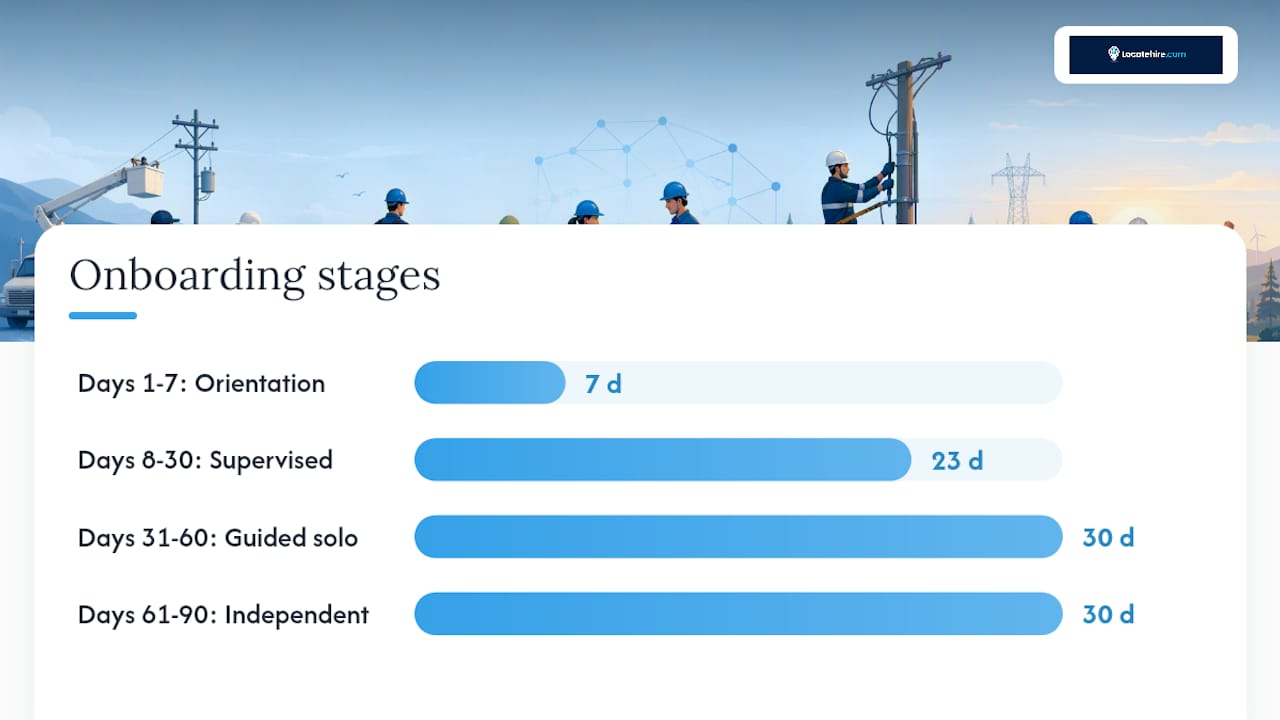
| Milestone | Focus | Sample Task |
|---|---|---|
| Days 1-7 | Orientation, safety, tool issue | Complete PPE fitting, pass lockout/tagout quiz |
| Days 8-30 | Supervised fieldwork | Shadow 15+ jobs, log observations in a shadowing checklist |
| Days 31-60 | Guided solo jobs | Handle 3 low-complexity service calls with mentor on standby |
| Days 61-90 | Independent verification | Complete two solo jobs with zero rework, mentor sign-off |
A 60-day template built for mid-level field technicians organizes onboarding around compliance, clarification, culture, and connection, with vehicle and PPE verification required before any solo deployment, per MangoApps' field service onboarding template.
At each milestone, run a short review against these questions:
- Did the technician meet the safety and documentation requirements for this stage?
- Does the mentor's feedback support moving forward, or does it flag a gap?
- Should you graduate the technician, extend supervised training, or add remedial modules?
Safety, Certifications, and Compliance Checks
No technician touches a live panel or client site until core safety modules are done. That means PPE use, lockout/tagout procedures, and hazard communication (HazCom/SDS) training where the role involves chemical exposure.

If the job requires driving a company vehicle, verify the technician's license, run a motor vehicle record (MVR) check, and confirm any state-specific electrical licensing before dispatch. Keep a single owner responsible for certificate files and set calendar flags 60 days before any license or certification expires, so renewals never catch you off guard.
Pro Tip: Bundle the safety module completion, vehicle inspection, and mentor approval into one sign-off form instead of three separate ones. A single document beats chasing three signatures across different systems, and it gives you one clean record for audits.
Tools, Vehicle, and Software Access Checklist
Before a technician rolls out on their first job, confirm they have what they need physically and digitally.
- Tools: issue a standard kit (meters, testers, hand tools) and log serial numbers against the technician's name
- Vehicle: run a pre-trip inspection covering lights, tires, and stocked parts, signed off by a supervisor
- Software access: confirm logins for the field service management app, email, timesheet system, and photo-upload permissions before day one ends
- Password handoff: use a secure password manager rather than texting credentials
If a tool goes missing or a login fails during the first 30 days, route the issue to one point of contact (usually the office manager) so it gets resolved within a day, not a week.
Ride-Alongs, Mentorship, and Hands-On Skills Practice

Passive ride-alongs, where a new hire just watches, teach less than structured shadowing that assigns specific things to observe and ends with a debrief. Active shadowing paired with a checklist and a short after-job conversation produces faster competence gains and keeps mentors consistent in how they model the work, according to ClarityOpsEngine's research on structured shadowing.
Run active shadowing this way:
- Give the technician 2-3 specific things to watch for before each job (wiring sequence, safety checks, customer communication).
- Debrief for five minutes after the job: what worked, what they'd do differently.
- Log the debrief notes in the technician's file.
Mentors are responsible for documenting each shadowed job and flagging any safety or skill concern to the manager within 24 hours, not at the next scheduled review.
- Set a "training wheels" period for the first solo jobs: low-complexity calls only, with the mentor reachable by phone, guided by a practical maintenance playbook and templates useful for property and maintenance teams.
- A field technician training plan should include safety protocols, standard operating procedures, and tools/systems training, along with a way to measure time-to-productivity, according to Trainual's training guide for field technicians.
Measuring Progress: Reviews and Documentation
A 15-minute weekly check-in for the first 90 days works better than a single 30-day review. Ask what's slowing the technician down, what feels unclear, and whether any safety concern came up that week. That single question doubles as a training checkpoint and a quiet audit of your own onboarding process, according to UC Davis HR's onboarding routine guidance.
Document each milestone with a signed form covering safety module completion, supervised job counts, and any quiz results. If a technician isn't hitting benchmarks by day 60, extend mentorship or add a remedial module rather than pushing them to solo work early. Store all sign-off evidence in your LMS or HRIS so it's ready for compliance audits and useful for future hiring decisions.
Common Onboarding Pitfalls and What They Cost You
The most frequent mistake: sending a technician to a client site before paperwork or safety training is fully documented. Close behind it is passive shadowing that never checks whether the new hire actually absorbed anything, and skipping software training until "later," which usually never comes.
Expect a senior technician to spend meaningful time mentoring during the first 30 days. That's a real cost in lost billable hours, but the alternative, a technician who causes rework or a safety incident, costs more.
Manager pro tip: batch onboarding when you're hiring two or more technicians at once, and keep training sessions short and focused rather than one long orientation day that nobody retains.
Why Treat Onboarding as a 90-Day Transition?
Thirty days isn't enough time to confirm a technician is truly ready for independent work. Weekly progress reviews through day 90 are what actually determine readiness and flag when supervised training needs to continue, per UC Davis HR's guidance.
- Keep the weekly check-in short and consistent, same day, same 15 minutes
- Extend training immediately if a safety concern or repeated error shows up, don't wait for the next scheduled review
For a longer view of structuring this window, see Locatehire's 90-day onboarding plan for HVAC teams, which applies directly to electrical field roles.
Onboarding Pays for Itself Faster Than Replacing a Bad Hire
A structured onboarding program costs supervisor time up front, but it's cheaper than the alternative: a technician who leaves in month three or causes a safety incident on-site. Track two numbers to prove the return: time-to-first-billable job and first-90-day rework rate.
Let Software Handle the Onboarding Paperwork Trail
Locatehire won't run your shadowing schedule or sign off on a lockout/tagout quiz, but it solves the part of onboarding that eats manager time: chasing paperwork, tracking who's completed what, and keeping records straight across multiple new hires at once.

If you're managing this checklist across spreadsheets and email threads, centralizing preboarding documents, automated reminders for expiring certifications, and stored sign-off evidence in one system removes a lot of the manual follow-up. When you evaluate any applicant tracking platform for this, check that it handles document storage, automated reminders, and role-based access for mentors and supervisors, since those are the features that map directly to the checklist above. Locatehire is built around exactly that kind of tracking for small service teams hiring electricians, HVAC techs, and plumbers. If you want to see how it fits your onboarding process, visit Locatehire and check it against your own checklist.
Sources
- Onboarding routine and 90-day guidance — UC Davis HR
- How to Onboard Technicians in 30 Days — FieldInsight
- Technician onboarding: phased pre-boarding and structured shadowing — ClarityOpsEngine
- Field service technician onboarding template — MangoApps
- New employee training guide for field technicians — Trainual