
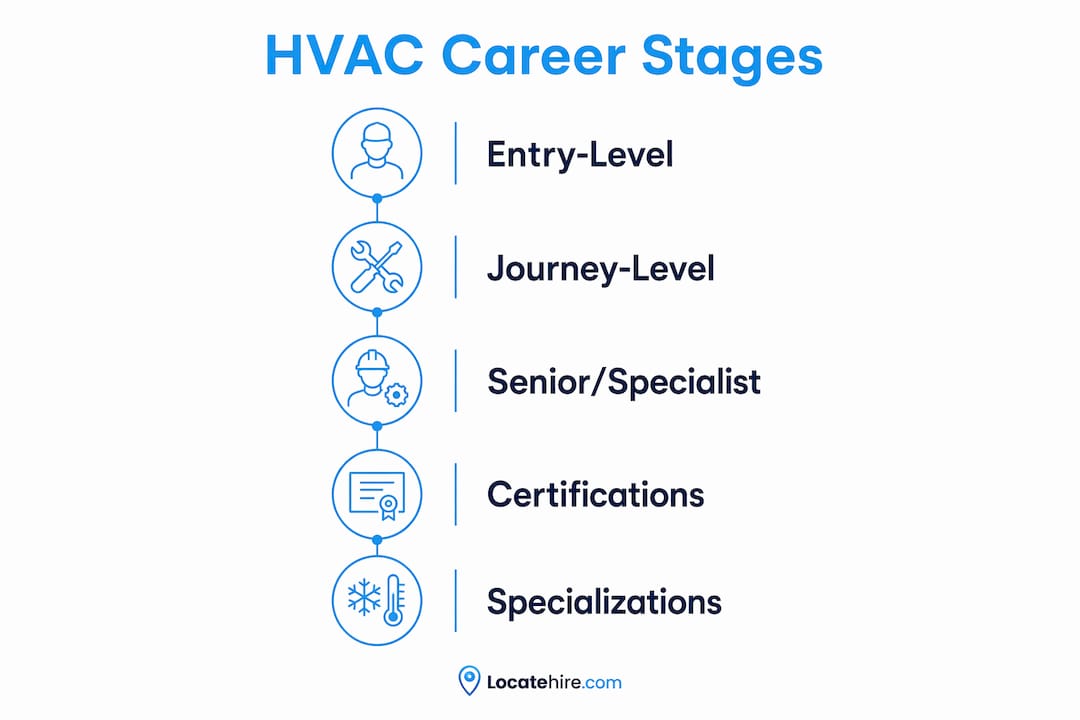
The HVAC technician career path moves through three clear stages: entry-level apprentice or helper, journey-level technician, and senior or specialist roles. Getting there requires formal training, hands-on experience, and at minimum one federally mandated certification. Here is what that progression actually looks like in 2026.
The path typically starts with a trade school certificate or apprenticeship, builds through years of field work, and opens into specializations like building automation, commercial refrigeration, or facilities management. Every technician who handles refrigerants must hold EPA Section 608 certification regardless of state. That credential is not optional. It is a federal requirement.
At a glance, the HVAC technician career path includes:
- Entry-level roles: HVAC helper, apprentice, or trainee for the initial period
- Training options: certificate programs lasting months to a couple of years or longer apprenticeships with paid on-the-job training
- Mid-level: journey-level technician working independently after gaining sufficient experience
- Certifications: EPA Section 608 (required), NATE (strongly recommended)
- Senior roles: service manager, system designer, controls technician, facilities manager
- Specializations: residential, commercial, building automation, energy efficiency, refrigeration
- Salary growth tied directly to experience, certification level, and specialization
What does the HVAC technician career path look like at the entry level?
Most people enter the HVAC field as a helper, trainee, or apprentice. The job title varies by employer, but the work is consistent: you assist experienced technicians, handle basic maintenance tasks, and absorb as much as possible on every job site.
Early duties include insulating refrigerant lines, cleaning furnaces, replacing filters, and running tools for senior techs. Over time, entry-level technicians take on more complex work like checking electrical circuits and cutting and soldering pipes. The learning curve is steep, but the earn-while-you-learn structure makes it accessible.
Training duration at this stage spans from 6 months to 5 years, depending on whether you choose a fast-track certificate or a full apprenticeship.
Common entry-level training paths:
- Certificate programs: Completed in 6 months to 2 years at trade schools or community colleges; focus on system fundamentals, safety, and hands-on lab work
- Apprenticeships: Typically 3–5 years; combine paid field work with classroom instruction each year
- On-the-job training: Many employers hire helpers with a high school diploma and train them directly alongside experienced technicians
EPA Section 608 eligibility starts here. Most certificate programs build exam preparation into the curriculum, and passing the test before entering the workforce gives you a clear advantage over candidates who have not yet earned it. Check the HVAC job posting examples that small businesses actually use to see what employers expect from entry-level applicants.
How do HVAC technicians grow into mid-level, journey-level roles?
The journey-level technician stage is where most of the real skill development happens. At this point, you work independently on service calls, diagnose system failures without supervision, and start building a reputation with customers and employers.

Reaching this stage typically takes 2–5 years of field experience after completing your initial training. The work shifts from assisting to leading. You are responsible for the full service call: diagnosing the problem, sourcing parts, completing the repair, and communicating the outcome to the customer.
Skills that define the journey-level technician:
- Mechanical troubleshooting across heating, cooling, and refrigeration systems
- Reading and interpreting blueprints and wiring diagrams
- Working with computerized and networked HVAC components
- Customer communication and service documentation
- Independent job site management without direct supervision
NATE certification becomes a real career lever at this stage. NATE credentials signal to employers that you have passed a rigorous, industry-recognized exam and are not just relying on years of experience alone. Many employers pay more for NATE-certified technicians, and some require it for senior roles.
This is also when technicians begin exploring specializations. A journey-level tech who starts focusing on commercial systems, controls, or energy efficiency is building the foundation for a senior role. The customer service dimension of this work is often underestimated. Residential technicians especially need strong communication skills to retain clients and generate referrals.
What senior and specialized roles can HVAC technicians move into?
Senior HVAC roles split into two directions: management and technical specialization. Both offer higher pay and, for many technicians, less physical strain than daily field work. The physical demands of HVAC work lead many experienced techs to seek roles that keep them off rooftops and out of crawl spaces.

Service managers oversee teams of technicians, handle scheduling, manage customer relationships, and ensure quality control across jobs. System designers and facilities managers work more in office or planning environments, specifying equipment, reviewing blueprints, and coordinating large-scale installations. These roles typically require 7 or more years of field experience plus demonstrated leadership ability.
Senior and specialist career options include:
- Service manager: Leads a technician team, handles dispatch and quality oversight
- Facilities manager: Manages HVAC systems across a commercial or industrial property portfolio
- System designer: Specifies and plans HVAC installations for new construction or retrofits
- Building automation technician: Programs and maintains smart building control systems
- Controls technician: Focuses on electronic and digital control systems for complex HVAC setups
- Commercial refrigeration specialist: Works on large-scale refrigeration systems in food service, cold storage, and industrial settings
Ongoing education matters at this level. Manufacturer-specific certifications, building automation credentials, and continuing education through organizations like ASHRAE keep senior technicians current as systems grow more technologically complex. See how HVAC companies compete for talent at this level to understand what employers are prioritizing in 2026.
What training, certifications, and licenses do U.S. HVAC technicians need?
Training and certification requirements in the U.S. follow a clear structure, though state licensing rules add a layer of variability. Understanding all three elements before you start your career saves time and prevents compliance gaps.
Training pathways
| Training path | Typical duration | How you learn | Key consideration |
|---|---|---|---|
| Trade school certificate | 6 months to 2 years | Classroom and hands-on lab | Fastest path to entry-level work |
| Apprenticeship | Up to 5 years | Paid on-the-job with annual classroom instruction | Earn wages while building skills |
| Associate degree | About 2 years | Classroom and lab | Broader coursework; longer pre-employment timeline |
Employers increasingly prefer candidates who have completed structured training combining classroom instruction with lab work, not just on-the-job experience alone. As HVAC systems incorporate more digital controls and networked components, employers want technicians who understand the theory behind the technology, not just the physical installation.
Apprenticeships typically run 3–5 years and allow technicians to earn wages throughout, making them a lower-debt alternative to traditional college programs.
EPA Section 608 certification
The EPA Section 608 certification is a federal mandate. Any technician who handles refrigerants must hold it, full stop. There are four certification types:
- Type I: Small appliances
- Type II: High-pressure systems
- Type III: Low-pressure systems
- Universal: Covers all system types
Most technicians pursue Universal certification to maximize their employability. The exam is typically included in postsecondary HVAC programs, so completing a certificate or degree program usually means you sit for the test before graduation.
Additional certifications and state licensing
Key certification and licensing facts:
- NATE certification is voluntary but widely valued by employers for mid-level and senior roles
- Manufacturer-specific credentials (from equipment brands) demonstrate specialized product knowledge
- State licensing requirements vary; some states require a contractor's license for certain project values or permit-required work
- A driver's license is typically required to travel between job sites
Pro Tip: Balance formal education with field hours early. Employers in 2026 want technicians who can read a wiring diagram and explain a repair to a homeowner in the same afternoon. Lab-based training builds the first skill; every service call builds the second.
For a detailed breakdown of qualification requirements by certification type, the 2026 HVAC technician qualifications guide covers current credential standards in depth.
Which HVAC specializations offer the strongest career growth?
Specialization is where the HVAC career path accelerates. A generalist technician has broad value, but a technician who has mastered commercial refrigeration or building automation systems commands higher pay and faces less competition for open roles.
The residential versus commercial divide is the first major choice most technicians face. Residential HVAC work tends to be less technically complex but requires strong customer service skills, since you are working in people's homes and explaining repairs directly to homeowners. Commercial work involves larger, more intricate systems and typically pays more, but demands deeper technical knowledge and comfort with industrial-scale equipment.
Common HVAC specializations and what they offer:
- Residential HVAC: High customer interaction, consistent demand, strong base for building a service route or independent business
- Commercial HVAC: Larger systems, higher technical complexity, higher earning potential
- Building automation systems (BAS): Programs and maintains smart controls for commercial buildings; growing fast as buildings become more connected
- Energy efficiency and green systems: Focuses on system performance, retrofits, and compliance with energy codes; increasingly relevant as efficiency standards tighten
- Commercial refrigeration: Serves food service, grocery, cold storage, and pharmaceutical industries; specialized and well-compensated
- Controls technician: Works on electronic and digital control systems; bridges HVAC and IT skill sets
Specialization also opens the door to independent contracting. Technicians with a niche skill set and an established client base can build their own service business, often starting with residential clients and expanding into commercial accounts. The apprenticeship pipeline that feeds these specializations is a topic employers and workforce developers are actively investing in for 2026 and beyond.
What salary ranges can HVAC technicians expect at each career level?
Salary in HVAC tracks closely with experience, certification level, and specialization. Entry-level technicians earn less while building skills, but the trajectory upward is consistent and well-documented.
At the entry level, helpers and apprentices earn wages that reflect their limited independent capability. Pay increases as technicians complete their training, earn EPA Section 608 certification, and begin working service calls without supervision. Journey-level technicians with NATE certification typically earn noticeably more than their non-certified peers in the same market.
Senior roles and specializations push earnings higher still. Service managers and facilities managers add supervisory responsibility to their technical expertise, and that combination commands a premium. Commercial HVAC and building automation specialists tend to out-earn residential generalists, reflecting the greater technical complexity of the work.
Factors that directly affect HVAC technician pay:
- Geographic location: Markets in the Northeast, West Coast, and major metro areas generally pay more than rural or lower-cost-of-living regions
- Certification level: EPA Section 608 Universal and NATE credentials both correlate with higher offers
- Specialization: Commercial, refrigeration, and controls roles typically pay above the residential average
- Employer type: Union contractors, large commercial firms, and facilities management companies often offer higher base wages and better benefits than small residential shops
- Experience: Each year of verified field experience adds negotiating leverage, particularly at the journey-level and senior stages
Benefits packages at established HVAC employers often include health insurance, retirement contributions, paid time off, and employer-sponsored continuing education. Some union positions add pension benefits and structured wage scales that increase automatically with years of service. For technicians who go independent, income potential is higher but benefits require self-funding.
The HVAC field continues to grow as aging building stock requires upgrades and new construction drives installation demand. That sustained demand keeps wages competitive and gives skilled technicians real leverage when negotiating offers at every career stage.
Key Takeaways
The HVAC technician career path rewards structured training, mandatory EPA certification, and deliberate specialization with clear advancement and competitive pay at every stage.
| Point | Details |
|---|---|
| Three career stages | The path moves from entry-level helper or apprentice, through journey-level technician, to senior or specialist roles. |
| Training length varies widely | Certificate programs typically last several months to a couple of years; apprenticeships can span 5 years with paid on-the-job learning. |
| EPA Section 608 is mandatory | Federal law requires this certification for any technician who handles refrigerants, regardless of state. |
| NATE certification accelerates advancement | NATE credentials are widely recognized by employers and correlate with higher pay at mid and senior levels. |
| Specialization drives the highest earnings | Commercial HVAC, building automation, and refrigeration roles consistently pay above the residential generalist average. |
Locatehire helps you hire qualified HVAC technicians faster

Finding certified HVAC technicians at every career stage is a real challenge for small businesses. Locatehire is an AI-powered recruitment platform built specifically for businesses with ongoing hiring needs, including HVAC contractors, plumbing companies, and electrical service firms.
Locatehire matches you with qualified candidates, tracks applicants efficiently, and keeps your hiring pipeline moving without the administrative overhead. If you are staffing entry-level helpers or searching for a NATE-certified journey-level technician, Locatehire gives you the tools to find and hire the right person faster.