

Demand for journeyman electricians is concentrated right now in data-center corridors, gateway union metros, and EV/renewables infrastructure work. The BLS projects about 81,000 annual openings for electricians through 2034, with a growth rate that outpaces most skilled trades. Live-market pay in mission-critical corridors and gateway union metros is often 40–80% above BLS benchmarks in active markets. If you want to find journeyman electrician positions fast, here are your three immediate moves:
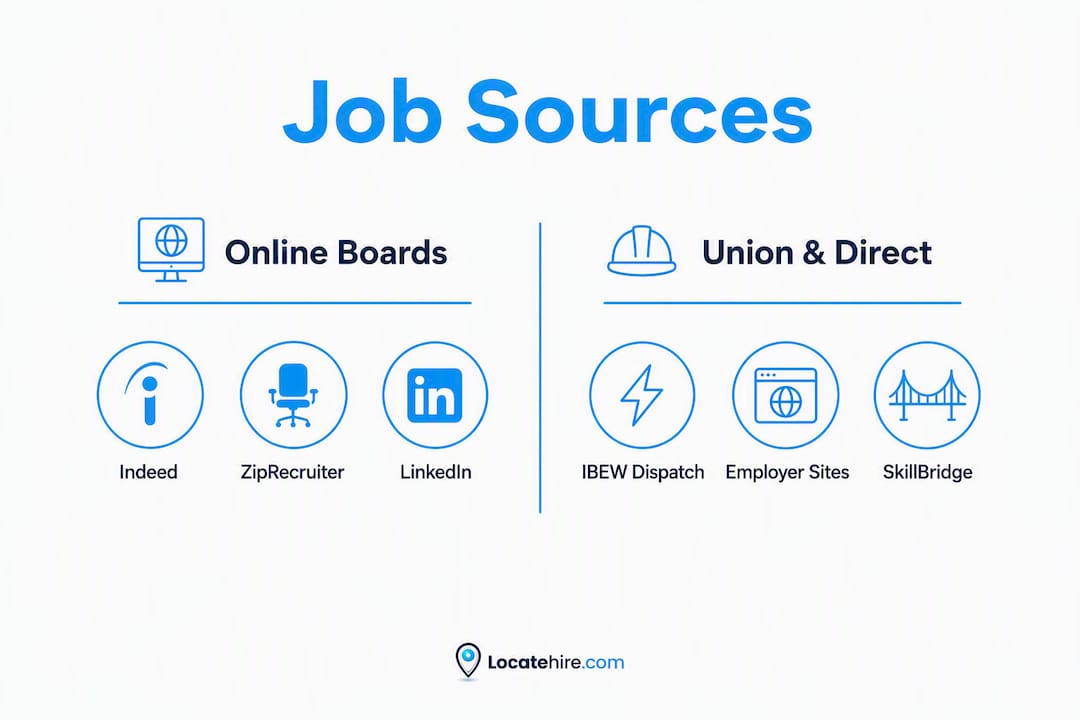
- Set targeted job alerts on Indeed, ZipRecruiter, and LinkedIn using "journeyman electrician" plus your target metro or "travel/per diem."
- Contact IBEW, IEC, and NECA dispatch in your target market directly. Union halls often have openings that never reach public job boards.
- Apply directly to contractors doing data-center builds, EV charging infrastructure, or large-scale solar. Their career pages frequently post before the boards do.
Market signal: The BLS median pay for electricians is $62,350 annually (2024 data), but live offers in mission-critical corridors and gateway union metros regularly exceed that figure by a wide margin. Prioritize live offer data over published averages when evaluating any opportunity.
Locatehire's AI-powered applicant tracking system also lets contractors post openings to major boards instantly, so checking employer career pages and applying through those postings puts you in front of hiring managers faster.
Table of Contents
- Where do journeyman electricians find the best job openings?
- Which metros offer the highest pay and most openings right now?
- What pay can you realistically expect as a journeyman electrician?
- Which employers and sectors are actively hiring journeyman electricians?
- How do you go from job search to hired as a journeyman electrician?
- How does licensing work, and how do you move between states?
- What do hiring managers actually look for when sourcing journeymen?
- What does the career path from journeyman to top earner actually look like?
- Your job-search checklist and outreach templates
- Key Takeaways
- The journeyman market is tighter than most people realize
- Reliable sources to check for live openings and market signals
Where do journeyman electricians find the best job openings?
The channel you use determines how fast you get an interview and what kind of work you land. Each source below serves a different goal.

Primary job boards
Indeed, ZipRecruiter, and LinkedIn are the fastest starting points for electrician job opportunities. Set role-specific alerts with filters for "journeyman electrician," your target city or state, and pay range. ZipRecruiter's matching algorithm surfaces roles you might not find manually. LinkedIn is particularly useful for industrial and data-center contractors who post there before anywhere else.
Pro Tip: On Indeed, save a search for "journeyman electrician" + "per diem" to surface travel roles that often pay $10–$20/hr above local market rates.
Union channels
IBEW dispatch is the most direct path to union-scale work. Walk into or call your target local's dispatch hall, register as available, and ask about current job calls. NECA contractor networks and IEC chapters post openings for both union and open-shop commercial work. Understanding how IBEW dispatch works before you call saves time and signals professionalism.
Employer career pages and staffing firms
Large data-center contractors, utilities, and industrial employers often post openings on their own career pages days before they hit the boards. Staffing and temp agency channels are worth using for travel or per-diem assignments, especially when you want to test a new market before relocating.
SkillBridge for transitioning service members
The DOD SkillBridge program connects transitioning military personnel with electrical contractors for internship-style placements that frequently convert to full-time journeyman positions. If you have a military background, this channel gets you in front of contractors who actively recruit from it.
| Channel | Speed to interview | Pay expectation | Screening intensity |
|---|---|---|---|
| Indeed / ZipRecruiter | 1–5 days | Market rate | Moderate (ATS + phone screen) |
| 3–7 days | Market to premium | Moderate to high | |
| IBEW dispatch | Same day to 1 week | Union CBA scale | License verification required |
| NECA / IEC contractor networks | 3–10 days | Union or open-shop | Moderate |
| Employer career pages | 3–7 days | Often above board average | High (multi-step) |
| Staffing / temp firms | 1–3 days | Market rate + per diem | Low to moderate |
| SkillBridge | 2–4 weeks | Entry to journeyman scale | Moderate |
Combining two or three channels simultaneously is the most reliable way to generate multiple offers and negotiate from a position of strength.
Which metros offer the highest pay and most openings right now?
Not all markets are equal. The table below maps the highest-priority corridors by typical pay range, dominant work type, and fastest application channel.
| Metro / Corridor | Typical pay range | Dominant work type | Fastest channel |
|---|---|---|---|
| San Francisco / Bay Area | $65–$75/hr | Data centers, commercial, EV | IBEW Local 6 dispatch, LinkedIn |
| New York City | $65–$75/hr | Commercial, utilities, transit | IBEW Local 3 dispatch, NYC Jobs |
| Northern VA / DC (data-center corridor) | $55–$72/hr | Mission-critical data centers | Employer career pages, LinkedIn |
| Seattle / Portland | $55–$68/hr | Commercial, industrial, renewables | IBEW locals, Indeed |
| Chicago | $50–$65/hr | Industrial, commercial, utilities | IBEW Local 124, ZipRecruiter |
| Los Angeles | $50–$65/hr | Commercial, solar, EV charging | IBEW Local 12, Indeed |
| Denver | $55–$65/hr | Commercial, data centers | IBEW Local 68 dispatch |
| Dallas / Fort Worth | $44–$58/hr | Commercial, industrial, EV | Indeed, ZipRecruiter, NECA |
| Atlanta | $40–$55/hr | Commercial, data centers | Indeed, employer pages |
| Houston | $40–$53/hr | Industrial, petrochemical, utilities | Indeed, NECA contractors |
Pay ranges reflect live-market offer bands by metro, not BLS state averages. Gateway union markets like San Francisco and New York sit at the top because CBA schedules are negotiated to local cost-of-living. Denver's IBEW Local 68 moved from $70.09 to $77.64/hr in Q2 2026, a clear signal that CBA negotiations are accelerating in mid-tier markets too.
When relocation isn't an option, target travel or per-diem roles in high-demand corridors. Northern Virginia's data-center build-out, for example, draws journeymen from across the Mid-Atlantic and Southeast on per-diem schedules that effectively close the cost-of-living gap.
How to pick your target metro: Compare the pay uplift against your current cost of living. A $55/hr role in Denver may net more than a $65/hr role in San Francisco once housing is factored in. Use the BLS state wage data as a floor, then verify live offers on Indeed and ZipRecruiter before committing to a move.
What pay can you realistically expect as a journeyman electrician?
Journeyman pay ranges from roughly $34/hr in lower-cost non-union markets to $75/hr in gateway union metros. Typical metro ranges run $34–$75/hr, with the highest levels in San Francisco, New York, and other union gateway markets. That spread is wide enough that where you work and what you specialize in matters more than almost anything else.
What moves your rate
- Union vs. open-shop: The union premium averages $10.62/hr nationally and widens to $15–$20/hr in dense metros. Union packages also include pension, annuity, and health benefits that add significant value beyond the base rate.
- Specialty skills: Medium-voltage, commissioning, controls, and battery energy storage systems (BESS) work commands premiums. Mission-critical roles report base rates of $45–$60/hr, with full packages running $120K–$250K for senior journeymen and foremen on large projects.
- Overtime and per diem: A journeyman working 50–55 hours per week on a data-center project with a $50/hr base and $150/day per diem can clear $120K+ annually without a foreman title.
- Retention bonuses: Common on large mission-critical projects with tight timelines. Ask about them explicitly when negotiating.
How to read an offer
Don't evaluate a job offer on base rate alone. Ask for the all-in picture: base rate, overtime rules (1.5x or double-time thresholds), per-diem amount, health insurance cost to you, pension or annuity contribution, and expected weekly hours. A $48/hr offer with full union benefits, double-time after 8 hours, and $175/day per diem often beats a $58/hr open-shop offer with no benefits and no overtime premium.
Pro Tip: Before accepting any offer, ask the hiring manager: "What did a journeyman working full schedule here take home last year?" That single question surfaces overtime patterns, shutdown weeks, and bonus structures that the posted rate never shows.
Which employers and sectors are actively hiring journeyman electricians?
The sectors below are driving the bulk of current electrician job opportunities. Each has a different work rhythm, pay ceiling, and career trajectory.
Commercial construction remains the largest employer of journeyman electricians by volume. General contractors and electrical subcontractors on office, retail, and multifamily projects hire steadily in most metros. Pay is solid but rarely reaches mission-critical premiums.

Industrial maintenance and manufacturing offers steady hours and often union-scale pay. Refineries, auto plants, food processing facilities, and distribution centers need journeymen for both project work and ongoing maintenance. Reliability and willingness to work rotating shifts matter more here than in commercial work.
Data centers and mission-critical facilities are the highest-paying segment right now. Hyperscale builds in Northern Virginia, Phoenix, Dallas, and the Pacific Northwest are pulling journeymen from across the country. The work requires medium-voltage experience, commissioning familiarity, and the ability to pass rigorous background checks.
Utilities and transmission hire for long-term stability. Linework and substation construction pay well and often include strong pension benefits. The hiring process is slower and more credential-intensive than commercial work.
EV charging infrastructure and large-scale solar/BESS are the fastest-growing segments. NEVI-funded charger rollouts and utility-scale solar projects are creating thousands of new journeyman positions. The work is often project-based and travel-heavy, but per-diem packages make it financially attractive.
Residential service and renovation rounds out the picture. Pay is lower than commercial or industrial, but the work is steady and geographically flexible. For journeymen building hours toward a master license, residential service work often provides the broadest exposure to code compliance and troubleshooting.
How do you go from job search to hired as a journeyman electrician?
Follow this sequence to move from search to offer as efficiently as possible.
- Audit your license and renewals. Confirm your journeyman license is current in your home state. If it's expiring within 90 days, renew before applying. Expired licenses kill offers at the background-check stage.
- Build a short field resume. Two pages maximum. Lead with a "Quick Skills" header listing your certifications (NFPA 70E, OSHA 30, medium-voltage, BESS, controls) and total OJT hours. Hiring managers scan for these in the first 10 seconds.
- Set job alerts on all three major boards. Indeed, ZipRecruiter, and LinkedIn. Use "journeyman electrician" plus your target metro and "per diem" as separate alert strings.
- Tailor applications for mission-critical roles. If you have any data-center, medium-voltage, or commissioning experience, call it out explicitly in the application. Generic resumes get filtered out by ATS systems before a human sees them. Understanding electrician candidate screening from the employer's side helps you write past those filters.
- Contact IBEW, IEC, and NECA dispatch in your target market. Call, don't email. Introduce yourself, confirm your license status, and ask about current job calls or upcoming projects.
- Prepare two references. Foremen or general foremen who can speak to your reliability, attendance, and specific skills. Have their names and direct phone numbers ready before any interview.
- Interview prep. Hiring managers for commercial and industrial roles ask about NFPA 70E compliance, OSHA card status, medium-voltage experience, tool ownership, and availability for overtime. Have specific answers ready for each.
Pro Tip: Add a two-line "Quick Skills" header directly below your name and contact info on your resume: list certifications on one line and high-value experience (medium-voltage, BESS, commissioning, controls) on the second. This format gets past ATS filters and gives a recruiter an immediate reason to call.
How does licensing work, and how do you move between states?
Licensing for journeyman electricians is fragmented. Most states issue their own journeyman or master electrician license, and many cities and counties add a separate local license on top of the state credential. There is no single national journeyman license. Reciprocity agreements exist between some states but are inconsistent and change without much notice.
Before targeting a new market, take these steps:
- Check your home state's reciprocity agreements with the target state through the state electrical licensing board. CareerOneStop's license finder tool is a reliable starting point.
- Research city-level requirements. New York City, Chicago, and several other major metros require a separate city license even if you hold a valid state credential.
- Prepare transportable documentation. Get a verification letter from your home state board, gather your apprenticeship completion certificate, and have your OJT hours documented. Employers and IBEW locals in new markets will ask for these before dispatch.
- Obtain widely recognized certificates. NFPA 70E and OSHA 30 are accepted everywhere and signal hire-readiness to any employer regardless of state.
The structural shortage in electrical labor means many contractors are willing to help with licensing paperwork for candidates who bring the right skills. Ask about it directly when negotiating an offer in a new state.
What do hiring managers actually look for when sourcing journeymen?
Contractors running active hiring programs use five channels to source journeymen: registered apprenticeships (IBEW/NECA Electrical Training ALLIANCE, IEC, ABC), SkillBridge and military transition pipelines, employee referrals, trade-school pipelines, and lateral hires from adjacent trades. Knowing which channel you fit into helps you get in front of the right decision-maker faster.
What hiring managers prioritize, in order:
- Verified, current license. Non-negotiable. An expired or out-of-state license without confirmed reciprocity stops the process immediately.
- Attendance and discipline record. Contractors talk to each other. A clean record from your last two foremen is worth more than any certification.
- Trade-specific experience. Medium-voltage, commissioning, and controls experience are the fastest paths to premium offers. List them prominently.
- OSHA 30 and NFPA 70E cards. Required on most commercial and all mission-critical sites. Have physical copies ready.
- Two clean references. Direct phone numbers, not email. Hiring managers call references before extending offers on premium roles.
The hire-ready checklist employers run through before extending an offer:
- License verification (current, correct state or confirmed reciprocity)
- Documented OJT hours or apprenticeship completion certificate
- OSHA 30 card
- NFPA 70E certification
- Two references with direct contact numbers
- Availability for site-specific safety orientation
- Drug screen and background check clearance
Pro Tip: If your background includes solar installation, low-voltage systems, or industrial maintenance, frame it explicitly on your resume as transferable electrical experience. ATS filters at large contractors screen for these keywords, and recruiters use them to justify routing your application to a journeyman role rather than a helper position.
AI screening tools are increasingly part of the hiring workflow at larger contractors. Understanding how AI fits into modern hiring helps you write a resume that clears automated filters before a human ever reads it.
What does the career path from journeyman to top earner actually look like?
The standard progression runs: apprentice → journeyman → foreman → general foreman → master electrician. Each step carries a pay multiplier, but the size of that multiplier depends heavily on market and sector.
A journeyman in a gateway union market earning $65/hr can expect a foreman rate of $72–$80/hr and a general foreman rate above that. In mission-critical work, senior journeymen and foremen on large projects report total packages of $120K–$250K when overtime, per diem, and benefits are included.
What accelerates the climb:
- Medium-voltage and switchgear experience opens doors to the highest-paying data-center and utility projects.
- Commissioning and controls certifications are increasingly required on mission-critical builds and command a direct pay premium.
- NFPA 70E and manufacturer training (Square D, Eaton, Siemens) signal readiness for high-voltage work and are often paid for by the employer.
- Supervisory experience. Even one project as a working foreman builds the reference and track record needed to move into permanent foreman roles.
The master electrician license is the ceiling credential. Requirements vary by state, but most require 4,000–8,000 hours as a journeyman plus a written exam. In states with strong reciprocity, a master license dramatically expands your geographic leverage.
Your job-search checklist and outreach templates
Use this checklist before submitting any application or making any contact.
- Journeyman license current and verified (or reciprocity confirmed for target state)
- Field resume updated: "Quick Skills" header, certifications listed, total OJT hours noted
- Two references identified with direct phone numbers
- OSHA 30 and NFPA 70E cards scanned and saved as PDFs
- Job alerts set on Indeed, ZipRecruiter, and LinkedIn
- Target metro IBEW local, IEC chapter, and NECA contractor list pulled
- Follow-up schedule set: call union halls Monday morning, follow up on board applications within 5 business days
Union hall / dispatch outreach template:
Contractor hiring manager email / LinkedIn InMail template:
Pro Tip: Reference the specific job ID from the board posting in every application email. It signals you read the posting carefully and makes it easier for the hiring manager to pull your application from the ATS queue.
Key Takeaways
The journeyman electrician job market is structurally short on supply, with 81,000 annual openings projected through 2034 and live-market pay in mission-critical corridors and gateway union metros regularly running 40–80% above BLS benchmarks.
| Point | Details |
|---|---|
| Set targeted alerts immediately | Use Indeed, ZipRecruiter, and LinkedIn with "journeyman electrician" plus your target metro and "per diem." |
| Contact union dispatch directly | IBEW, IEC, and NECA locals often have job calls that never reach public boards. |
| Prioritize mission-critical metros | Northern VA, Bay Area, New York, and Denver offer the highest live-market pay for qualified journeymen. |
| Specialize to raise your ceiling | Medium-voltage, commissioning, and BESS experience unlock the $45–$60/hr base tier and premium packages. |
| Assemble hire-ready documents now | License verification, OSHA 30, NFPA 70E, and two references with direct phone numbers close offers faster. |
The journeyman market is tighter than most people realize
The conventional take on the electrician shortage focuses on the headline number: roughly 20,000 retirements annually against apprenticeship programs adding 35,000–45,000 net new journeymen per year. On paper, that looks manageable. It isn't. The 81,000 annual openings projected by BLS represent a demand level that training pipelines haven't caught up to, and electrification-driven work, specifically EV infrastructure, utility-scale BESS, and hyperscale data centers, is adding demand faster than the industry expected even two years ago.
What I'd watch closely over the next two quarters: CBA negotiations in IBEW locals in Denver, Dallas, and the DC corridor, where Q2 2026 data already shows rapid movement. NEVI-funded charger rollouts are beginning to hit construction phase in earnest, which means EV infrastructure hiring rounds are coming. Hyperscale data-center contractors are running continuous hiring programs, not project-by-project searches.
The journeymen who will capture the best offers are the ones who cross-specialize. A journeyman with commercial experience who adds a medium-voltage ticket and an NFPA 70E card becomes a candidate for mission-critical work almost immediately. That's a $15–$25/hr pay difference in most markets. The investment in a short manufacturer training course or a weekend NFPA class pays back in weeks, not years.
Locatehire tracks these market signals and helps contractors post openings to major boards the moment a project kicks off. If you're a contractor reading this, that speed-to-post advantage matters in a market where qualified journeymen are fielding multiple offers simultaneously.
Reliable sources to check for live openings and market signals
Checking the right sources weekly keeps your job search current and your pay expectations calibrated to real offers, not published averages.
U.S. Bureau of Labor Statistics (BLS): Use the Occupational Outlook Handbook for long-term growth projections and national median pay. Check it quarterly for updated employment figures, not weekly. It's the authoritative baseline, not a live-market tool.
Indeed, ZipRecruiter, and LinkedIn: Check weekly for new postings in your target metros. Run a fresh search rather than relying solely on alerts, since algorithm changes occasionally suppress relevant results. These boards reflect immediate demand better than any other source.
IBEW local CBA schedules: Public collective bargaining agreements for IBEW locals are posted on local union websites and show current journeyman rates, overtime rules, and benefit contributions. Checking these before negotiating in a union market gives you the exact floor to negotiate from.
NECA and IEC contractor networks: NECA's market notes and IEC chapter job boards surface commercial and industrial openings that don't always appear on general job boards. Worth checking monthly.
CareerOneStop license finder: The license verification tool at CareerOneStop is the fastest way to confirm reciprocity requirements before targeting a new state.
Locatehire's platform lets contractors post openings to major boards instantly and set up candidate alerts, so applying through employer career pages powered by Locatehire puts your application in front of hiring managers at the moment a role opens. Visit locatehire.com to see how the platform works for electrical contractors actively hiring journeymen.