
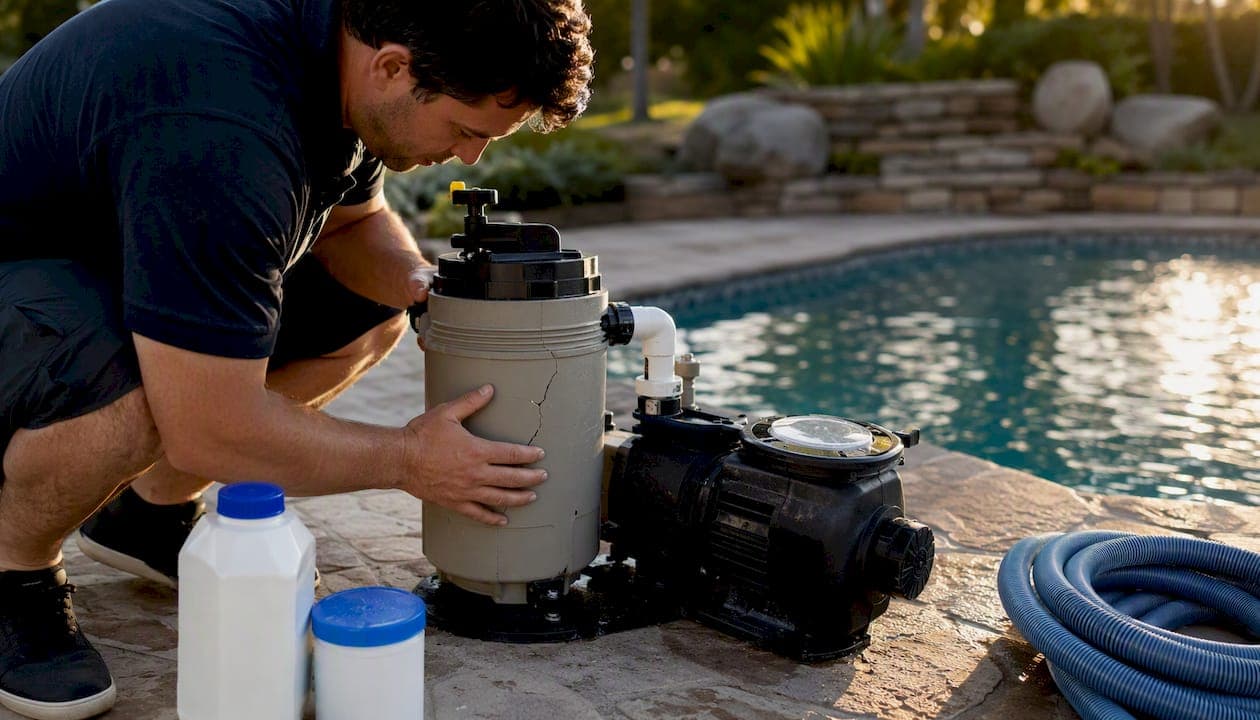
Upselling should be your highest-margin, retention-driving growth lever — when it operates as problem-solving, not pressure selling. On a well-run route, upsell revenue contributes 20–35% of total maintenance revenue. This week, pick two upsell items, train three techs on the Observe→Document→Recommend workflow, and run a 6-week pilot with clean tracking.
- Pick two upsells from the high-conversion list below (chemical program upgrade and filter cleaning are the lowest-risk starting points).
- Train three techs on the documentation checklist and a one-sentence recommendation script.
- Track three numbers from day one: attach rate per visit, average ticket, and regret rate.
That single target focuses tech behavior without creating sales pressure.*
Key Takeaways
A structured upsell program is the fastest way to increase per-account revenue on an existing pool route without adding new clients.
| Point | Details |
|---|---|
| Target revenue share | Aim for upsell revenue to reach 20–35% of total route revenue on mature routes. |
| Regret rate guardrail | Keep the regret rate below 5% by documenting every recommendation with a photo before presenting it. |
| Start with low-risk items | Chemical program upgrades and filter cleaning require no contractor license and generate recurring margin. |
| Licensing boundaries | Equipment installation above ~$500 in California and Florida typically requires a contractor license — refer or subcontract when in doubt. |
| Locatehire for staffing | Locatehire's AI-powered ATS helps pool service businesses run fast hiring sprints to keep upsell-ready techs on every route. |
Table of Contents
- What does upselling actually mean in pool service?
- Which upsell opportunities convert best on a pool route?
- How do you find and present upsells on every route visit?
- When should you refer or subcontract instead of doing the work yourself?
- How do you train techs and staff to run an upsell program?
- How should you quote, document, and invoice upsell work?
- What KPIs and revenue benchmarks should you track?
- What does a 6-step rollout plan look like?
- What are realistic U.S. price ranges for common upsells?
- How do you segment customers to tailor upsell offers?
- When and how often should you present upsells to avoid client fatigue?
- How do you handle objections and convert hesitant clients?
- How does upselling affect long-term retention and lifetime value?
- What do successful upsell campaigns look like in pool service?
- An operator's perspective on upselling done right
- Staffing your upsell program with the right techs
- Sources
What does upselling actually mean in pool service?
The terms "upsell," "add-on," and "cross-sell" get used interchangeably in the field, but the distinctions matter for contracts, billing, and licensing.
Upsell: A deeper or higher-value version of a service already in the maintenance agreement. Example: upgrading a customer from a basic chemical program to a premium algaecide-plus-phosphate-removal plan. The work stays within the same service category.
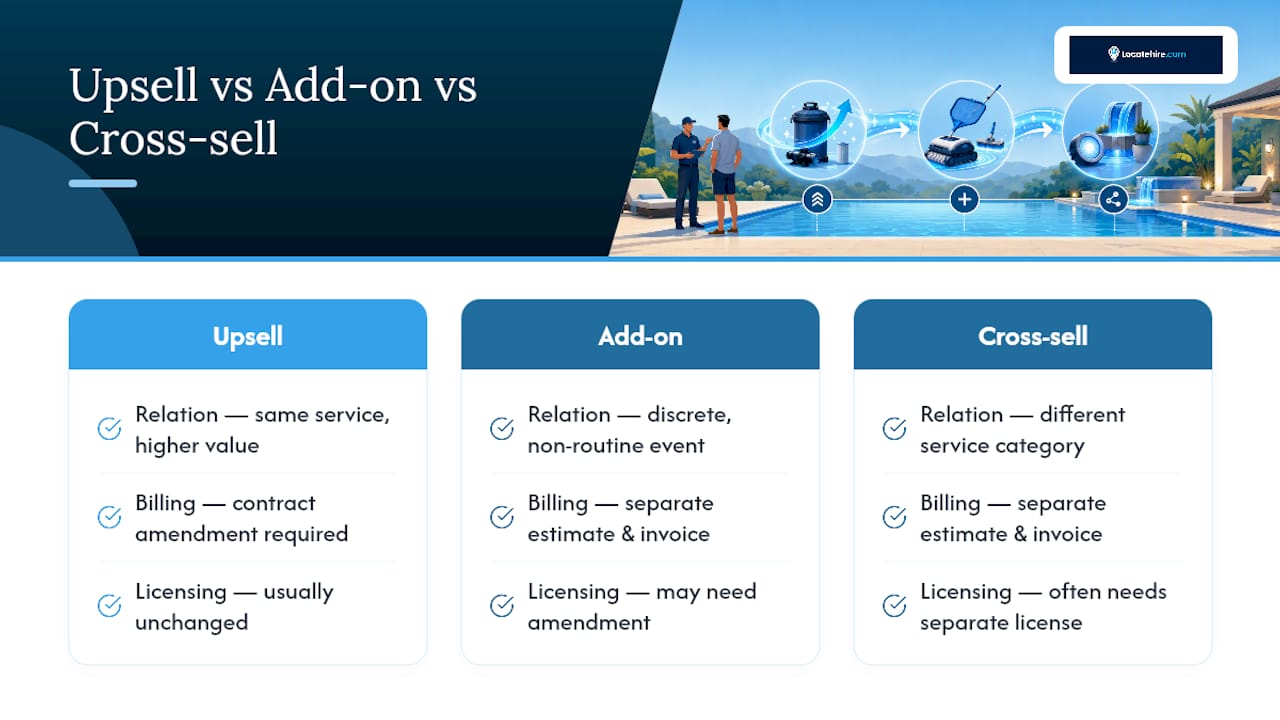
Add-on: A discrete, non-routine event that sits outside the regular visit scope. Example: a one-time acid wash or a seasonal pool opening. It requires a separate estimate and often a separate invoice.
Cross-sell: A different service category entirely. Example: offering pressure washing or lawn care alongside pool maintenance. This frequently triggers separate licensing requirements and insurance considerations.
The practical reason to keep these categories clean: your maintenance agreement almost certainly defines scope. Performing work outside that scope without a written amendment can void your insurance coverage on that job, create billing disputes, and in some states, constitute unlicensed contracting. Pool Business Forum's guidance on upselling specifically flags that documented scope amendments protect both the business and the client when work expands beyond the original contract.
Which upsell opportunities convert best on a pool route?
Not all upsells are equal. The items below are ranked roughly by conversion frequency and margin profile, based on operator-reported data from Pool Founder.
-
Chemical program upgrades. The highest-frequency upsell category because no contractor license is required and the margin is recurring. Moving a client from a basic chlorine program to a phosphate-removal or enzyme-treatment plan adds $20–$60 per month with minimal labor.
-
Filter cleaning. Cartridge and DE filter cleans are easy to observe, easy to photograph, and easy to explain. Clients understand dirty filters. Typical ticket: $75–$150 per service.
-
Salt system conversion. A one-time equipment project ($800–$2,500 installed) that often leads to a higher-tier chemical program. Clients value the reduced chlorine smell; you gain a recurring chemical margin bump.
-
Variable-speed pump retrofit. Energy savings are quantifiable, which makes the ROI conversation straightforward. California's Title 20 standards and similar state efficiency rules in Florida and Texas have made this a compliance-driven upsell in many markets. Typical installed cost: $600–$1,400.
-
Automation and control upgrades. Smart controllers (Pentair IntelliConnect, Hayward OmniLogic) run $500–$2,000 installed. They sell on convenience and remote monitoring, not just efficiency.
-
LED lighting upgrades. Low licensing risk in most states when replacing a like-for-like fixture. Tickets range from $200–$600. The visual impact is immediate, which helps close the sale on-site.
-
Green-pool remediation. Demand is weather-driven and urgent. A full green recovery (algaecide, brush, vacuum, rebalance) runs $150–$400 and often converts clients to a higher-tier maintenance plan afterward.
-
Equipment repair and replacement. Heaters, pumps, and automation boards. Higher tickets ($300–$3,500+), but licensing thresholds apply in many states — see the compliance section below.
-
Seasonal openings and closings. Strong in Sun Belt markets that experience mild winters. Bundled packages ($150–$350) sell well when presented in early spring or late fall.
-
Safety and compliance fixes. Drain cover replacements under 16 CFR Part 1450 (the Virginia Graeme Baker Pool and Spa Safety Act) and barrier/gate repairs triggered by local inspection cycles. These are time-limited, urgency-driven upsells with clear liability protection for the client.
Pro Tip: *Before pitching any upsell, verify the need with a photo and a measurement.
How do you find and present upsells on every route visit?
The Observe→Document→Recommend framework from Florida's Best Pools gives techs a repeatable, low-pressure process that positions every recommendation as professional advice rather than a sales pitch.
Observe happens during the standard service inspection. Techs check equipment, water chemistry, surfaces, and safety hardware on every visit. The goal is not to find something to sell — it is to find something that genuinely needs attention.
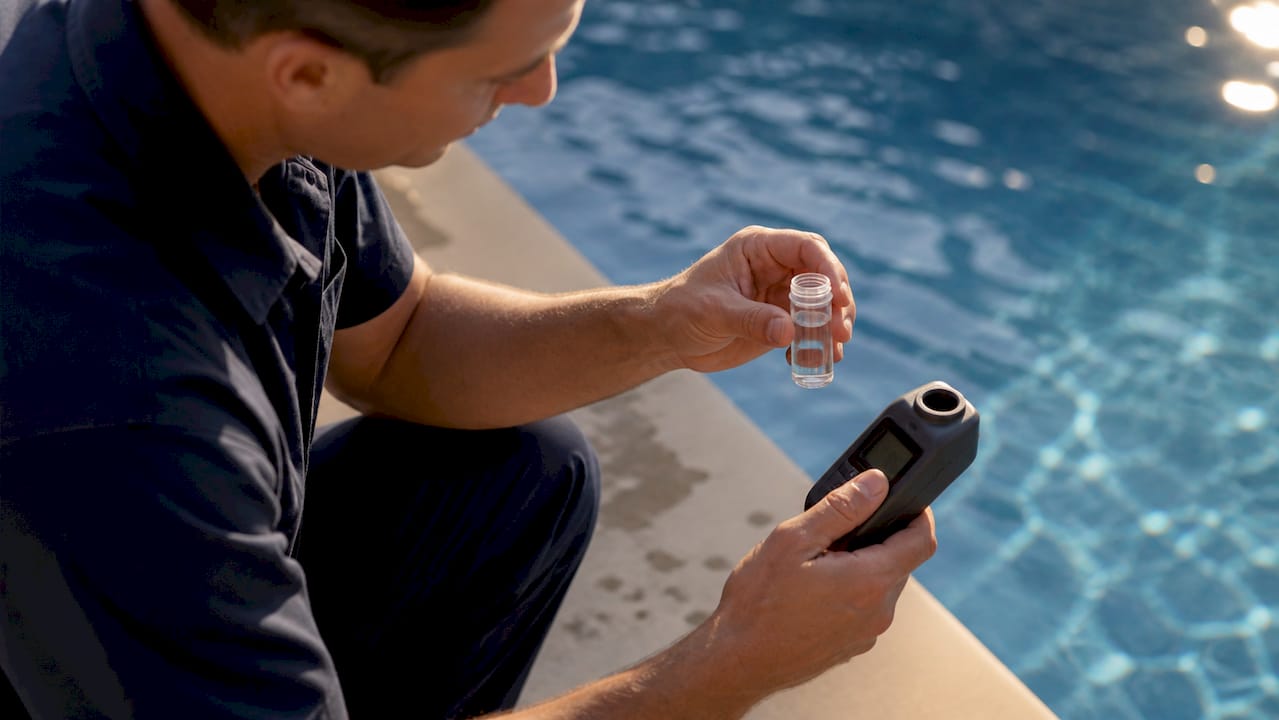
Document means photographing the finding and logging it in the CRM or job note before leaving the property. A photo of a cracked filter housing or a cloudy phosphate reading is evidence. Evidence removes the "I didn't notice anything wrong" objection before it starts.
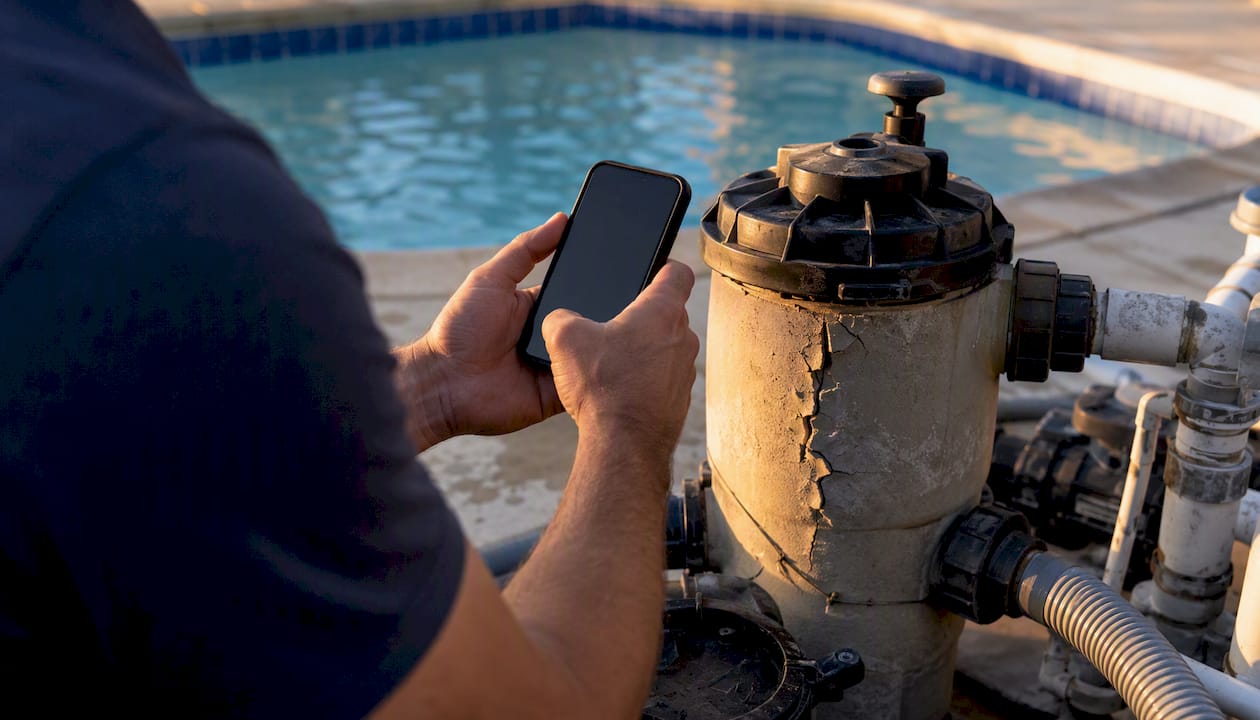
Recommend is the client-facing step. The tech (or office staff following up) presents the finding, the photo, and a one-line ROI or safety rationale. The recommendation is framed as an invitation, not a close.
Prioritize findings by urgency tier before presenting:
- Safety-critical (broken drain covers, failed GFCI, barrier gaps): present immediately, in writing.
- Deferred maintenance (worn pump seals, dirty filters, low salt cell output): present at the next scheduled visit or via a follow-up email with the photo attached.
- Elective upgrades (LED lighting, automation, salt conversion): present during a seasonal review or when the client mentions a renovation.
Pro Tip: A three-window intake approach — book the visit first, diagnose on-site, then offer one add-on — keeps the conversation focused and reduces the chance a client shops the upsell to a competitor.
When should you refer or subcontract instead of doing the work yourself?
Three boundaries govern whether you can upsell a service or must refer it out: licensing, insurance, and contractual scope.
Licensing. Electrical work (installing automation panels, replacing underwater lighting with new conduit runs), gas work (heater installation), and structural repairs typically require a licensed contractor in most states. California's CSLB C-53 pool contractor license covers pool construction and major equipment installation; Florida's DBPR residential pool licensing covers similar scope. Performing this work without the correct license exposes you to fines, voided insurance, and civil liability. The International Code Council publishes the model codes many jurisdictions adopt for pool barriers and safety standards — knowing your local adoption status tells you which compliance cycles create legitimate upsell windows.
Insurance. General liability policies for pool maintenance often exclude installation work or cap coverage at a specific dollar threshold. Before upselling any equipment project above roughly $500, confirm your policy covers the scope. If it does not, either add an endorsement or subcontract to a licensed installer and charge a project management fee.
Contractual scope. Your maintenance agreement defines what a "visit" includes. Work outside that definition requires a written scope amendment signed by the client before you start. Pool Business Forum's upselling guidance recommends keeping a standard amendment template that specifies parts, labor, warranty terms, and the client's authorization signature.
When you subcontract, protect yourself with three steps: get a copy of the subcontractor's license and insurance certificate before the job starts, issue a written scope amendment that names the subcontractor, and confirm your own liability policy covers project management of third-party work.
How do you train techs and staff to run an upsell program?
The right hire for an upsell-capable route is not a salesperson. You need a tech with diagnostic skills, comfort with a smartphone camera, and the communication confidence to deliver a one-sentence recommendation without flinching. Hiring for these attributes is the first operational step.
A structured onboarding sprint makes the difference between a tech who documents findings and one who skips the checklist under time pressure. Use a 7/30/60 model:
- Days 1–7: Teach the Observe→Document→Recommend checklist. Role-play three recommendation scripts. Shadow a senior tech on two routes.
- Days 8–30: Solo visits with daily photo review by a supervisor. Track attach rate and flag any regret-rate signals. Debrief weekly.
- Days 31–60: Full independence. Review KPIs monthly. Introduce the second upsell category (e.g., equipment triage after chemical programs are consistent).
For a detailed onboarding framework, this guide on training new pool service hires covers competency checkpoints that map directly to upsell readiness.
Incentive structure: Avoid straight commission. It creates pressure that inflates the regret rate. Add a monthly team bonus when the route's upsell revenue share clears a threshold — this builds collective accountability rather than individual competition.
Pro Tip: Post the regret rate on a shared dashboard. When techs see it as a team metric, peer accountability does more than any manager conversation.
How should you quote, document, and invoice upsell work?
Clean documentation is what separates a professional upsell program from a billing dispute waiting to happen. Keeping service pricing and project pricing visibly separate on invoices protects both your margin visibility and client trust.
Estimate template. Every upsell estimate should include:
- Scope description (specific work to be performed, not a category label)
- Parts and labor broken out separately
- Warranty terms (parts vs. labor, duration)
- Acceptance signature line with date
- Expiration date on the estimate (30 days is standard)
Scope amendment language. When adding work to an existing maintenance contract, use a one-paragraph amendment: "This amendment to Service Agreement #[X] dated [date] authorizes [specific work] at the agreed price of $[amount]. All other terms of the original agreement remain in effect. Client signature below constitutes authorization to proceed."
Invoicing. Issue a separate invoice for every upsell or project. Never fold a $400 filter housing replacement into the monthly maintenance invoice. Bundling obscures your true per-account profitability and makes it nearly impossible to track upsell revenue as a distinct line in your accounting software. Two invoices per visit (when upsell work occurs) is the correct practice.
What KPIs and revenue benchmarks should you track?
Five metrics define a healthy upsell program:
- Upsell attach rate: percentage of service visits that generate at least one upsell recommendation accepted by the client.
- Upsell revenue share: upsell revenue as a percentage of total route revenue (target: 20–35% on mature routes).
- Average upsell ticket: total upsell revenue divided by number of upsell transactions.
- Regret rate: percentage of completed upsells where the client later expressed dissatisfaction or requested a reversal. Target: below 5%.
- Repeat-purchase rate for chemical programs: percentage of clients who renew a chemical upgrade after the first 90 days.
The revenue math is straightforward. One operator model from Superior Pool Routes estimates that add-ons can increase annual revenue by roughly $28,500 on a 60-account route. On a 50-account route at a more conservative attach rate, even $40/month in average chemical program upgrades per account adds $24,000 annually before any equipment work.
What does a 6-step rollout plan look like?
A time-boxed pilot removes the paralysis of "where do I start." Here is a concrete sequence:
-
Week 1 — Define pilot scope. Select two upsell items (chemical program upgrade and filter cleaning). Choose three techs. Set baseline KPIs from current route data.
-
Week 2 — Train. Run a half-day session covering the Observe→Document→Recommend checklist, photo documentation standards, and two recommendation scripts. Role-play objections.
-
Weeks 3–4 — Execute. Techs run the checklist on every visit. Office staff follow up on documented findings within 24 hours. Log every recommendation, acceptance, and decline.
-
Week 5 — Measure. Pull attach rate, average ticket, and regret rate. Identify the top-converting tech and the most common objection.
-
Week 6 — Go/no-go decision. Clear the bar (10% attach rate, regret rate below 5%) to scale. If you miss it, diagnose: is the issue documentation quality, script delivery, or follow-up timing?
-
Weeks 7–12 — Scale or iterate. Add a third upsell category (equipment triage or LED lighting). Expand to the full route. Review KPIs monthly.
Seasonal note: In Sun Belt markets, launch the pilot in February or March before peak season demand compresses tech schedules. For hiring the right techs before peak season, plan your recruiting 8–10 weeks ahead of your target start date.
One bad pattern caught early is far cheaper than a client-trust problem at scale.*
What are realistic U.S. price ranges for common upsells?
| Upsell Item | Typical U.S. Price Range | Margin Shape | Licensing Flag |
|---|---|---|---|
| Chemical program upgrade | $20–$60/month | Recurring | None in most states |
| Filter cleaning (cartridge/DE) | $75–$150/service | One-time, repeatable | None |
| Salt system conversion | $800–$2,500 installed | One-time + recurring chemical | Equipment installation license in some states |
| Variable-speed pump retrofit | $600–$1,400 installed | One-time + energy savings | C-53 (CA) or equivalent for full replacement |
| Automation/control upgrade | $500–$2,000 installed | One-time | Electrical license if new conduit required |
| LED lighting upgrade (like-for-like) | $200–$600 | One-time | Electrical license if new wiring required |
| Green-pool remediation | $150–$400/event | One-time, weather-driven | None |
| Seasonal opening/closing | $150–$350/event | One-time, seasonal | None in most states |
| Equipment repair (pump, heater) | $300–$3,500+ | One-time | Contractor license often required above ~$500 in CA/FL |
Price thresholds that commonly trigger licensing requirements vary by state. In California, any pool equipment installation or repair above $500 in combined labor and materials typically requires a CSLB C-53 license. Florida's DBPR residential pool licensing covers equipment installation and structural work. When a quote approaches these thresholds, confirm your license status before proceeding or subcontract to a licensed contractor.
How do you segment customers to tailor upsell offers?
Not every client is the same upsell opportunity. Segmenting your route by client type lets you match the right offer to the right conversation at the right time.
New clients (0–90 days): Focus on trust-building, not upselling. The first three months are for demonstrating reliability and documentation quality. The one exception: a safety-critical finding (broken drain cover, failed GFCI) must be presented immediately regardless of tenure.
Established residential clients (90+ days, single pool): Chemical program upgrades and filter cleaning are the natural entry points. These clients already trust your judgment. Present equipment upgrades after you have at least one documented finding to support the recommendation.
High-value residential clients (pools with automation, heaters, or water features): LED lighting, automation upgrades, and salt conversions convert well here. These clients invested in their pool and respond to convenience and efficiency arguments. Increasing customer lifetime value for this segment often comes from bundling two complementary upgrades (salt conversion plus variable-speed pump, for example) into a single project quote.
Commercial accounts: Safety and compliance upsells (VGB drain covers, barrier inspections, chemical documentation) are the primary opportunity. Commercial clients respond to liability reduction and regulatory compliance framing, not aesthetics or convenience.
Price-sensitive clients: Lead with ROI. A variable-speed pump's energy savings (often $30–$60/month on a residential pool) pay back the installation cost in 18–30 months. Frame the upsell as a cost-reduction tool, not a premium upgrade.
When and how often should you present upsells to avoid client fatigue?
Timing and frequency are where good upsell programs fail. Presenting too often trains clients to expect a pitch on every visit, which erodes trust faster than any single bad recommendation.
A practical cadence: present no more than one upsell recommendation per visit, and no more than two per month per client. Safety-critical findings are the only exception — those get presented immediately and in writing, regardless of recent communication frequency.
The best timing windows for non-urgent upsells are:
- Post-service summary: A brief text or email sent within two hours of the visit, with the photo and a one-line recommendation. Response rates are highest when the client can see the evidence while it is still fresh.
- Seasonal transitions: Early spring (pre-season equipment check) and late fall (closing prep) are natural moments when clients expect to hear about their pool's condition.
- After a problem is solved: A client who just experienced a green pool or a pump failure is more receptive to a preventive upgrade than one whose pool has been running perfectly for six months.
Avoid presenting elective upgrades (LED lighting, automation) during the same visit as a maintenance issue. The client's attention is on the problem, not the upgrade. Schedule a separate follow-up conversation for elective items.
How do you handle objections and convert hesitant clients?
The most common objections in pool service upselling fall into three categories: price, timing, and trust.
Price objections ("That seems expensive") respond best to ROI framing. For a variable-speed pump, calculate the monthly energy savings and show the payback period. For a chemical upgrade, frame it against the cost of one emergency green-pool call ($150–$400). Tying recommendations to measurable ROI and documenting the math for the client converts more hesitant buyers than any discount.
Timing objections ("Can we do it next season?") are often legitimate. Respect them for elective upgrades. For deferred maintenance items, document the finding in writing, note the risk of waiting, and set a follow-up date. A client who declines today and sees the same finding documented again in 60 days is far more likely to approve it.
Trust objections ("I want to get another quote") are a signal that the recommendation lacked evidence. The fix is upstream: a photo, a measurement, and a one-sentence explanation of the consequence of inaction remove most trust objections before they surface. When a client does ask for a second opinion, welcome it. Confidence in your recommendation is the most effective closing tool.
Use a simple three-step response for any objection: acknowledge the concern, restate the evidence, and offer a specific next step. "I understand the timing isn't ideal. The crack in the filter housing is documented in your service record, and I can hold the price on the part for 30 days. Want me to schedule it for your next visit?" That structure works across all three objection types.
How does upselling affect long-term retention and lifetime value?
Upselling done correctly turns a commodity service into a trusted advisory relationship. A client who has approved three documented recommendations from your team over 18 months is not shopping on price. Superior Pool Routes' analysis frames this directly: upselling serves dual purposes, lifting revenue and improving retention by positioning your tech as a trusted pool expert rather than a cleaner.
The retention mechanism is straightforward. Every completed upsell creates a documented service history that is specific to that client's pool. That history has real switching costs. A new provider starts from zero; your team already knows the equipment, the chemistry baseline, and the client's preferences. Clients who have invested in upgrades through you are also more likely to attribute good pool performance to your service, which reinforces renewal decisions.
Lifetime value compounds when chemical program upgrades are involved. A client on a $40/month premium chemical plan generates $480/year in upsell revenue on top of the base maintenance fee. Over a five-year relationship, that single upsell adds $2,400 in revenue from one account. Multiply that across 20 accounts on a 60-account route and the math becomes a meaningful part of how pool service businesses scale their route valuation.
Practical client retention tactics for service businesses consistently point to the same driver: clients stay when they feel their provider is proactively looking out for them. Documented upsell recommendations, even declined ones, signal that your team is paying attention.
What do successful upsell campaigns look like in pool service?
The most repeatable upsell campaigns in pool service share a common structure: they are triggered by a documented finding, presented with evidence, and tied to a clear outcome the client cares about.
Chemical program upgrade campaigns work well as a spring launch. Techs document phosphate levels above 500 ppb (a threshold where algae risk increases) across the route in March, then office staff send a batch of follow-up emails with the photo and a one-line explanation. Conversion rates on this type of evidence-based outreach are consistently higher than cold pitches because the client received a specific finding, not a generic offer.
Variable-speed pump campaigns tied to utility rebate programs have driven strong conversion in California and Texas markets. When a local utility offers a rebate on qualifying pumps, the effective client cost drops significantly, and the ROI math becomes much easier to present. Checking your local utility's rebate calendar (many update annually) and timing a pump campaign around rebate availability is a proven tactic.
Safety compliance campaigns around VGB drain cover replacements have worked well for operators who proactively audited their entire route before a local inspection cycle. Presenting the finding as "we checked your drain cover against the federal safety standard and it needs replacement" converts at a high rate because the framing is protective, not commercial. Pool Founder's operator guidance specifically notes that safety-driven upsells carry the highest client acceptance rates of any category.
The United Pool Association's growth guidance reinforces that combining a strong upsell program with consistent branding, review management, and Google Business Profile maintenance creates a compounding demand effect: more reviews attract new clients, and a higher upsell rate increases the revenue value of each one.
An operator's perspective on upselling done right
The operators who run the most profitable upsell programs share one discipline: they never pitch something they cannot document. That sounds obvious, but the pressure to hit a revenue number in a slow week creates real temptation to recommend a filter clean on a filter that is fine, or to push a salt conversion on a client who is happy with their current chemistry.
The litmus test that veteran pool service operator Joe Ford articulates in Florida's Best Pools' training library is the right standard: "Would you recommend this to your own mother?" If the answer requires any hesitation, the recommendation is not ready to present.
What I find most underestimated about upselling in pool service is the retention effect. Owners focus on the immediate ticket value and miss the compounding benefit: a client who has approved three recommendations from your team over two years is not a price-sensitive commodity client anymore. They are an invested partner in their pool's performance. That relationship is worth far more than any single upsell transaction, and it is built one documented finding at a time.
The upselling strategies that work at scale are not clever sales tactics. They are consistent operational habits: observe every visit, document every finding, recommend with evidence. The revenue follows the process, not the other way around.
Staffing your upsell program with the right techs
An upsell program is only as consistent as the techs executing it. Skill gaps in documentation, communication, or basic equipment triage kill conversion rates faster than any pricing or scripting issue. Predictable hiring and structured onboarding close those gaps before they cost you clients.
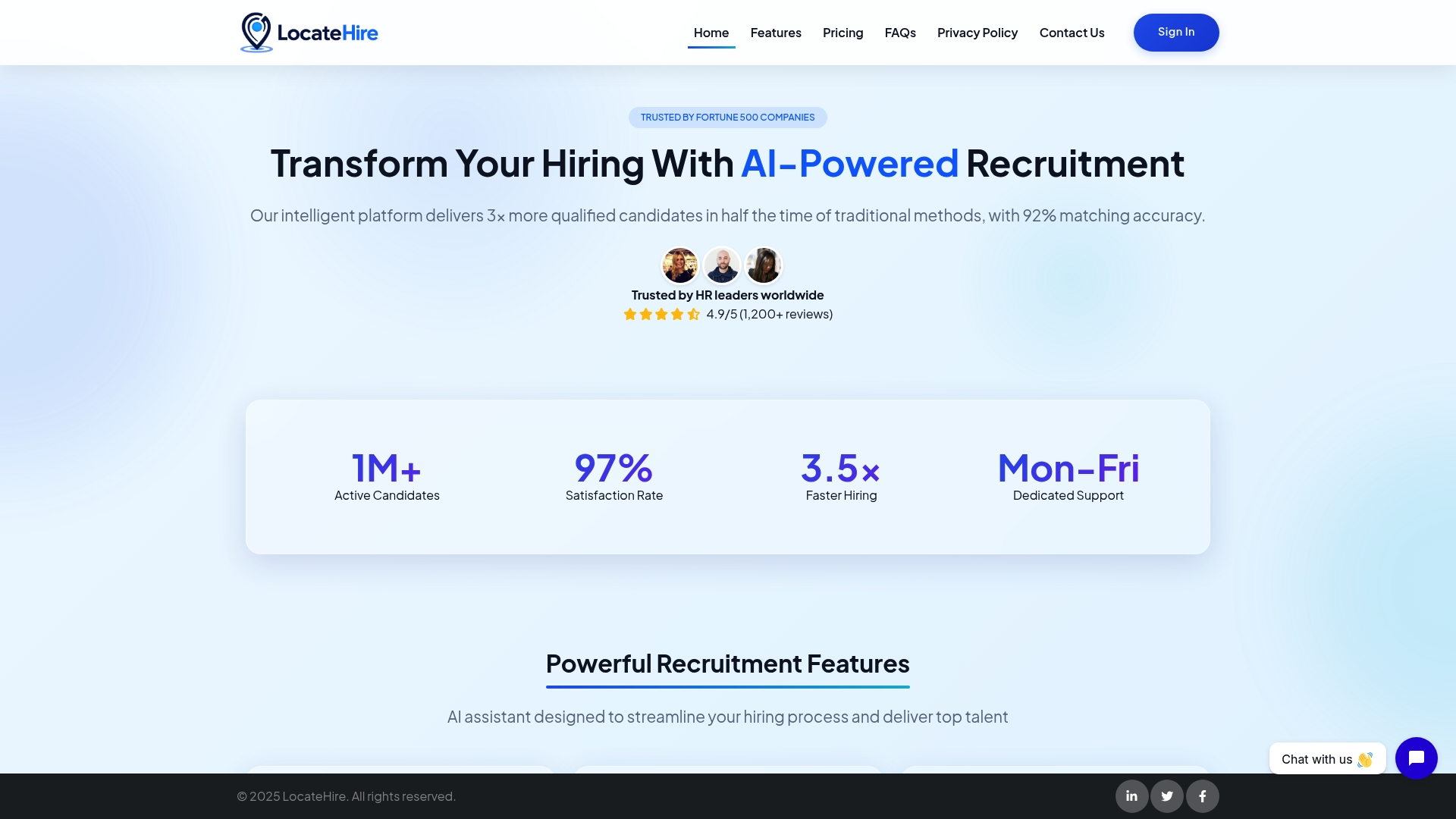
Locatehire is built for exactly this hiring pattern. Pool service businesses with ongoing tech needs can run a 7/30/60 hiring sprint using Locatehire's AI-powered candidate matching, smart scoring, and job posting to major boards and social media, all from a single platform. You get a pipeline of qualified candidates, not a stack of unscreened resumes. When a tech leaves mid-season or you need to scale ahead of peak demand, Locatehire keeps your hiring moving without slowing down your route operations. Start building your tech pipeline at Locatehire and keep your upsell program staffed with people who can actually execute it.
Sources
- How to Grow Your Pool Maintenance Business — United Pool Association